



For more than two centuries, the story of new technology has usually had a familiar cast of winners and losers. Machines took over physical and repetitive work; people with more education learned to design, manage or complement those machines. The factory worker faced the robot, while the engineer, accountant and manager often gained new leverage. Technology did not reward everyone equally, but it generally tilted the labour market towards higher-skilled workers.
Artificial intelligence may cloud that pattern.
In a new study of 273 European regions (including the UK) between 2000 and 2017, co-authored with Antonio Minniti and Klaus Prettner, we ask what happens to regional labour market when places began producing AI innovations. We find that AI weakens the position of highly skilled workers relative to low-skilled workers. Specifically, AI innovation reduced the relative wage bill for high-skilled labour by about 6.6 per cent. This is the result of a lower relative employment and relative wages.
Figure 1. Regional response of relative wage and relative employment to AI
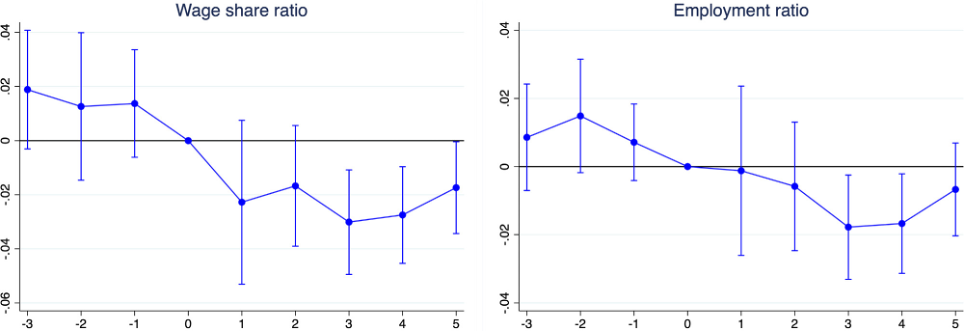
This finding does lend support to the view that when AI innovation arrived in a region, the total amount employers spent on high-skilled workers tended to fall compared with what they spent on low-skilled workers. That total combines two things: how many people are employed and what they are paid. The researchers find movement on both fronts.
A shrinking relative wage bill does not necessarily mean that salaries or jobs fell in absolute terms. High-skilled employment might still have grown, but more slowly than low-skilled employment. Pay might still have risen, but by less. The study is about a shift in the balance between groups, not a universal pay cut for graduates.
To identify that shift, we classify low-skilled workers as those with the least formal education and high-skilled workers as those with tertiary education, leaving out the middle group so that the contrast remained sharp. They then treated a region’s first AI-related patent as the moment when local AI innovation began.
On average, the high-skilled-to-low-skilled wage-cost ratio fell 6.6 per cent after AI innovation. Relative employment of high-skilled workers fell 3.2 per cent. The gap between those figures suggests that wages also played a part. In plain language, the adjustment was not only about fewer high-skilled jobs relative to low-skilled jobs; the relative price of high-skilled labour weakened too.
The most revealing result, however, is that Europe did not move as one.
In countries with the strongest specialisation in AI, the high-skilled wage-cost ratio fell by 12 per cent and relative high-skilled employment by 9.4 per cent. In countries with little AI capacity, the researchers found no meaningful effect. Occasional patenting activity by itself does not transform a labour market. AI has to sit within an ecosystem able to develop, absorb and use it.
The intermediate group of AI developing countries followed a different path. In these, the relative wage bill for high-skilled workers rose by 10.5 per cent, while their relative employment increased by 5.2 per cent. This finding may reflect as a possible transition. When businesses are still introducing AI, they may need more specialists to install systems, reorganise workflows and translate new tools into useful products. Once the technology and surrounding capabilities mature, substitution may become stronger.
That produces a more interesting picture than the familiar contest between optimists and pessimists. AI may first increase demand for highly skilled people and later reduce it for some of the tasks they perform. Implementation creates work; maturity changes who, or what, does the work. The same technology can complement skilled labour in one place and substitute for it in another.
There is also a geographical lesson. AI is not falling evenly across the map like rain. Innovation is clustered in a limited number of regions, and its labour-market effects depend on national and local capabilities. A policy debate focused only on occupations risks missing this. The consequences will be shaped not simply by whether someone is a lawyer, technician or clerk, but by whether their region contains the firms, universities, infrastructure and know-how that turn AI into productive capacity.
For governments, the finding complicates the standard answer to technological disruption: educate and retrain people. Skills still matter enormously, and the answer is certainly not less education. But “move up the skills ladder” is inadequate if AI can reach several rungs at once. Training policy must become more specific about which tasks people will perform, how those tasks combine with machines, and how workers can move when a profession is reorganised rather than simply eliminated.
Employers should draw a lesson too. If the productivity gains from AI come partly from reducing demand for cognitive labour, then firms face choices about where those gains go. They can use AI merely to cut headcount, or to redesign work so that people spend less time on routine analysis and more on judgment, relationships and accountability. Technology does not dictate the distribution of its rewards. Management decisions, bargaining power and public policy help determine it.
Workers, meanwhile, should be wary of both panic and complacency. The study covers a period ending in 2017, before generative AI became a mass-market tool. It cannot tell us what ChatGPT-style systems have done since. Nor is an AI patent the same as widespread adoption. Patents signal local knowledge and innovative capacity, but they do not measure how intensively every company uses a technology. The analysis compares regional averages, so it cannot show which individual occupations gained or lost.
And although the researchers use a careful design, this is not a controlled experiment. Regions that innovate in AI may differ from other regions in ways that are hard to capture fully. The results are persuasive evidence of an association shaped by the timing of AI innovation, not a guarantee that every new AI system causes the same effect everywhere.
Still, the paper gives us a valuable warning against fighting the last technological war. Industrial machines largely challenged physical labour. Earlier digital technologies often increased demand for graduates. The researchers’ comparison with information and communication technology reflects that older pattern: digitalisation was associated with stronger high-skilled employment, whereas the negative effects found in AI-intensive countries appear specific to AI.
That does not mean the labour market is simply reversing, with low-skilled workers becoming the new permanent winners. AI can automate routine tasks at every level, and the study measures relative positions rather than security or prosperity. A cashier and a consultant may both face pressure, even if the consultant’s advantage narrows. A smaller gap is not automatically a fairer or healthier economy.
The deeper point is that “skill” is no longer a reliable shorthand for exposure. The important unit may be the task: whether it can be described, predicted and reproduced from data; whether errors are easy to detect; whether a human must bear responsibility; and whether trust, dexterity or social understanding is essential. A job title bundles many such tasks together. AI can remove some, amplify others and change the value of the whole bundle.
For decades, the safest advice in a changing economy was to become the person who works with the machine rather than the person replaced by it. That remains useful, but it is no longer enough. Many highly educated workers are already the people working with the machine–and the machine is learning parts of their work.
The emerging divide may therefore be less about educated versus uneducated, and more about who owns AI, who can direct it, whose judgment remains indispensable and who has the power to claim a share of the productivity it creates. If this study is right, artificial intelligence is not merely another chapter in the old story of technology and skills. It is beginning to change the plot already.
That is why the next argument about AI should concern not only what it can do, but who gains, who adapts and who ultimately decides.
References
- Minniti, A., Prettner, K., Venturini, F. (2026). AI innovation and labor market polarization: Evidence from European regions, Economics Letters
- https://doi.org/10.1016/j.econlet.2026.113180
Francesco Venturini

