



Introduction
Europe is home to some of the most sophisticated health systems in the world, yet in recent winters parents have queued at pharmacies for children’s amoxicillin, people with diabetes have been switched between insulin products at short notice, and oncologists have rationed old, inexpensive chemotherapy agents. These are not failures of scientific innovation. Most of the medicines in short supply are cheap, off-patent generics that have been on the market for decades. That paradox is the heart of the problem, and it is fundamentally an economic one.
This blog sets out what the evidence tells us about the scale of the shortage problem, why markets for essential medicines keep failing, what this means for patients, and which policy responses are most likely to work. The timing matters: in May 2026 the European Parliament and Council reached a provisional agreement on the Critical Medicines Act (CMA), and the way it is implemented over the next few years will determine whether Europe breaks the cycle or simply manages it more efficiently.
The scale of the problem
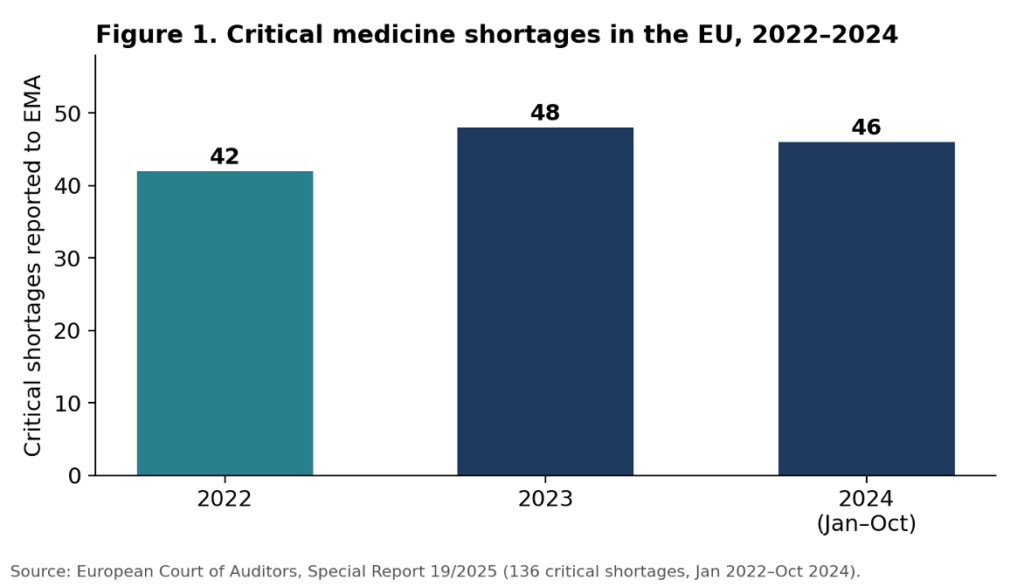
Measuring shortages is harder than it sounds. Member States define and report them differently, so cross-country comparisons are fragile, and many shortages are resolved at the pharmacy counter before they ever reach an official register. Even so, the direction of travel is unambiguous. The European Court of Auditors (ECA), in its 2025 special report, found that national authorities notified 136 critical shortages to the European Medicines Agency between January 2022 and October 2024, with record levels of 48 in 2023 and 46 in the first ten months of 2024 (Figure 1). Twenty-one of the 27 Member States reported at least one critical shortage in 2024, and in January 2024 nineteen EEA countries faced shortages of winter antibiotics.
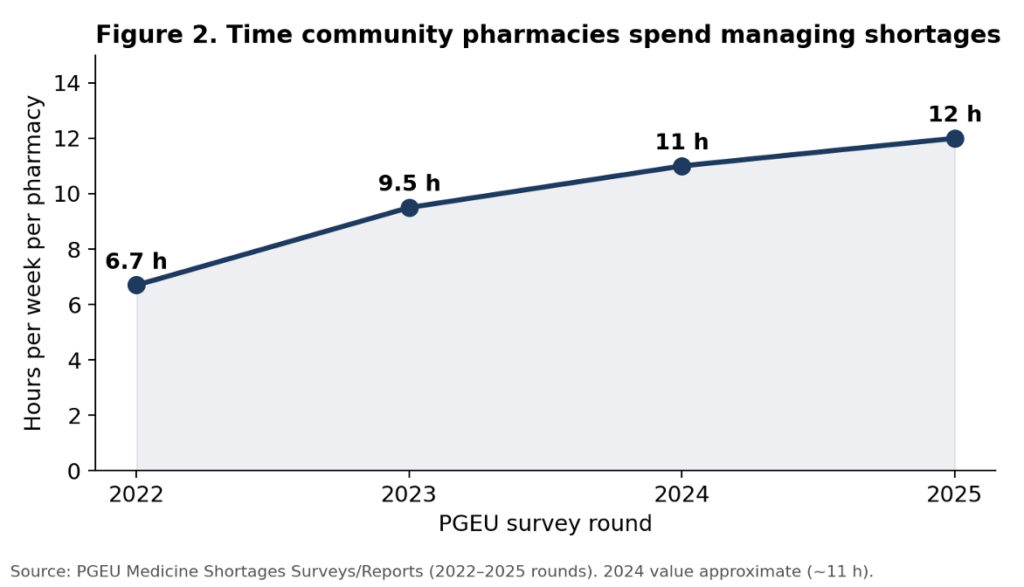
The view from the front line is even starker. The Pharmaceutical Group of the European Union (PGEU) surveys community pharmacy organisations every year. Its 2025 report, covering 27 EU and EFTA countries, found shortages in 96% of responding countries, with over 600 medicines in shortage in more than a third of them. Critically, the problem has shifted from acute to chronic: in 70% of countries the situation has stabilised, but at a level PGEU describes as unacceptably high. The time pharmacies spend managing shortages has almost doubled in four survey rounds, from 6.7 hours per week to around 12 hours (Figure 2), roughly one and a half working days each week that is not spent on patient care.
Why is this happening? An economic anatomy
The academic literature, notably the OECD’s review of shortages across its member countries (Chapman, Dedet and Lopert, 2022) and cross-country work by Vogler and Fischer (2020), converges on a common diagnosis. Shortages arise from the interaction of fragile supply with rigid demand, and the underlying driver is a market structure that systematically under-rewards reliability.
First, price. For many generics, the combination of external reference pricing, tendering, clawbacks and price caps has pushed prices towards marginal cost, and sometimes below it once inflation in energy, raw materials and regulatory compliance is taken into account. When margins are razor-thin, firms rationally exit the least profitable molecules, and they do not invest in redundant capacity, quality upgrades or safety stock. The ECA itself noted that the low reward for resilience in national procurement has intensified price pressure. In economic terms, the social value of a reliable supply includes a large option value that is simply not priced into the contract.
Second, concentration. Price competition has driven consolidation at every stage of the chain. For a number of essential molecules, the world depends on a handful of active pharmaceutical ingredient (API) plants, many located in China and India. Concentration generates economies of scale and low prices in normal times, but it also creates single points of failure. A contaminated batch, an export restriction, a factory inspection failure or a lockdown can remove a large share of global supply overnight, as COVID-19 made painfully clear.
Third, winner-takes-all tendering. Single-winner tenders that award a market to the lowest bidder for two or three years can deliver impressive short-run savings, but they squeeze out losing suppliers, who then leave the market or reallocate production elsewhere. When the winner falters, there is no one left to step in quickly. This is a classic case of a procurement design that optimises static efficiency at the expense of dynamic resilience.
Fourth, demand shocks and information failures. Demand for some medicines is highly seasonal and difficult to forecast, as the 2022–23 surge in paediatric respiratory infections showed. At the same time, visibility across the supply chain is poor. Wholesalers, parallel traders and pharmacies respond to perceived scarcity by ordering defensively, which amplifies small disruptions into large ones, the well-known bullwhip effect. National stockpiling obligations, introduced without coordination, can have the same effect at the level of countries, pulling supply from smaller or lower-price markets towards larger or higher-price ones.
Taken together, these features describe a market with a significant externality. Each purchaser captures the full benefit of a lower price but bears only a fraction of the collective cost of a fragile supply. Left alone, the market will under-supply resilience.
The effects on patients
The consequences for patients are real and often underestimated because they are diffuse. The PGEU 2025 survey reports patient distress in every responding EU Member State and treatment interruptions in 89% of them; for the first time, reduced trust in pharmacies was the most frequently cited consequence. A scoping review by Phuong and colleagues (2019) found evidence that shortages are associated with medication errors, adverse events, delayed or cancelled treatment and, in some settings, higher mortality.
Substitution is not a neutral act. Switching a patient with epilepsy, Parkinson’s disease or diabetes to a different formulation requires time, monitoring and clinical judgement. Replacing a first-line narrow-spectrum antibiotic with a broader-spectrum alternative can undermine antimicrobial stewardship. Shortages of older cancer drugs can force regimen changes with worse evidence behind them. Inequalities widen too: patients with lower health literacy, less time, or less ability to travel between pharmacies are the least able to navigate the system.
From a health economics perspective, the costs are therefore threefold: direct health losses (QALYs forgone through delayed or suboptimal treatment), additional resource use (clinician and pharmacist time, more expensive alternatives, hospital admissions), and a wider loss of trust in the health system. Very few of these costs are captured in the budgets of the procurement agencies whose decisions help create them, which is exactly why the problem persists.
How to solve it
There is no single fix, but the economics points to a coherent package. The guiding principle is to pay for resilience explicitly, rather than hoping it emerges as a by-product of price competition.
Reform procurement. Tenders for critical medicines should use most-economically-advantageous-tender criteria that reward supply security, multi-source awards that keep at least two or three suppliers active, and contract prices indexed to input costs. The CMA’s requirement to apply resilience criteria in public procurement of critical medicines is a major step, provided the weighting is meaningful and not cosmetic.
Create demand-side incentives for supply diversification. Rather than blanket reshoring, which is expensive and may simply relocate concentration, policy should target molecules where vulnerability is highest and reward diversification of API sources. The ‘EU preference’ options in the CMA need careful evaluation: well designed, they insure against geopolitical risk; poorly designed, they raise prices without improving reliability.
Coordinate stockpiling and joint purchasing. Stockpiles are insurance, and insurance is cheaper when risks are pooled. Coordinated EU-level buffer stocks and collaborative procurement for smaller Member States can reduce the destructive competition between countries during a crisis.
Improve information. A real-time, interoperable EU shortage monitoring platform with enforceable reporting obligations, something the ECA explicitly flagged as missing, would reduce the information asymmetries that drive panic buying and allow early intervention.
Empower the front line. Allowing pharmacists to substitute therapeutically equivalent products, adjust pack sizes, or compound where safe reduces the patient burden of shortages at low cost, and many countries have already moved in this direction.
Finally, evaluate. Each of these measures has costs, and those costs will ultimately fall on health budgets. The research agenda for our discipline is clear: we need robust estimates of the health and economic burden of shortages, value-of-information and real-options analyses of stockpiling and multi-sourcing, and rigorous ex-post evaluation of the CMA once it applies. Without that evidence, resilience risks becoming a slogan rather than a priced, accountable objective.
Conclusion
Europe’s medicine shortages are not an accident. They are the predictable outcome of markets that have been very effective at driving down the price of old medicines and very poor at valuing their reliable supply. The policy tools now on the table, above all the Critical Medicines Act and the reformed pharmaceutical legislation, create an opportunity to correct that imbalance. Whether they succeed will depend less on headline ambitions than on the unglamorous details of procurement design, pricing and data. That is precisely where health economists can, and should, make a difference.
Catia Nicodemo

