



Executive Summary
The article argues that sustainability is evolving from a compliance and reporting obligation into a fundamental driver of enterprise value and competitive advantage. Drawing on KPMG International’s 2026 global survey of 2,024 executives, alongside evidence from the OECD, Deloitte UK, and the London Sustainable Development Commission, the article highlights a significant “sustainability valuation gap” between executive awareness and financial action. While 72% of executives report a strong understanding of sustainability strategies and 60% consider sustainability in financial planning, only 19% use robust methods to quantify its impact on business performance and value creation.
The analysis demonstrates that regulation plays a critical role in driving sustainability integration. European countries with stronger reporting and disclosure requirements show higher levels of strategic commitment to sustainability than less regulated markets. Significant differences also exist across sectors, with banking, energy and automotive firms leading in the use of sustainability valuation techniques.
The article further argues that sustainability increasingly contributes to brand equity, investor confidence and entrepreneurial innovation. However, organisations require better measurement tools, financial frameworks and sustainability skills to convert environmental and social initiatives into demonstrable business value. Ultimately, sustainable business practices will become fully embedded only when they are expressed in the common language of value, risk and return.
1. Introduction
For much of the past two decades, boards, investors, and entrepreneurs have often regarded sustainability as merely an ethical addition to the core business—serving as a reporting requirement, a means of reputational protection, or, at best, a source of marginal differentiation. However, this perspective is now shifting. A growing body of evidence from international policy institutions, professional services firms, and city-level economic commissions indicates that organisations most vulnerable to sustainability-related risks are also those that stand to benefit significantly from viewing sustainability as a driver of enterprise value, rather than merely a compliance burden.
This article utilises new global survey data published by KPMG International in 2026, alongside research from the OECD on green entrepreneurship, the Deloitte UK green skills agenda, and the London Sustainable Development Commission’s study on London’s green economy. It explores why sustainability has become central to value creation, how public policy has influenced managerial behaviour, where significant gaps persist across countries and sectors, and how sustainability is increasingly recognised as a source of corporate and product brand equity. The core argument is clear: sustainability will be firmly integrated into business and entrepreneurial practices only when articulated in terms that resonate with finance, capital markets, and consumers—namely, value, risk, and return.
2. Why Sustainability Matters: Executive Awareness Versus Financial Action
2.1 The Board’s New Balance Sheet Item
Executive appreciation of sustainability-related risks and opportunities has never been higher. KPMG’s 2026 global survey of 2,024 senior executives across 19 countries found that 72 per cent have a detailed understanding of their organisation’s sustainability strategy, metrics and performance, or are at least familiar with its key aspects. Sixty per cent say they factor sustainability-related risks and opportunities into financial planning, half describe sustainability as integral to strategy, and 40 per cent connect it to innovation and product development. On the surface, this looks like a management discipline that has matured.
2.2 From Ambition to Attribution: The Perception Gap
Yet, only 19 per cent of these executives report utilising robust quantification methods—such as digital twins or Monte Carlo simulations—to assess how sustainability influences financial outcomes, operational improvements, or innovation. This discrepancy between expressed understanding and financial attribution is at the heart of what KPMG calls the ‘sustainability valuation gap’: the divide between the business rationale for sustainability and the enterprise value it can unlock. When this gap remains, commercial projects with genuine returns on investment often struggle to secure internal approvals, primarily because their sustainability-related benefits cannot be articulated in terms that align with finance department criteria. Furthermore, the costs of inaction remain unpriced until they manifest as stranded assets, lost contracts, or disengaged investors.
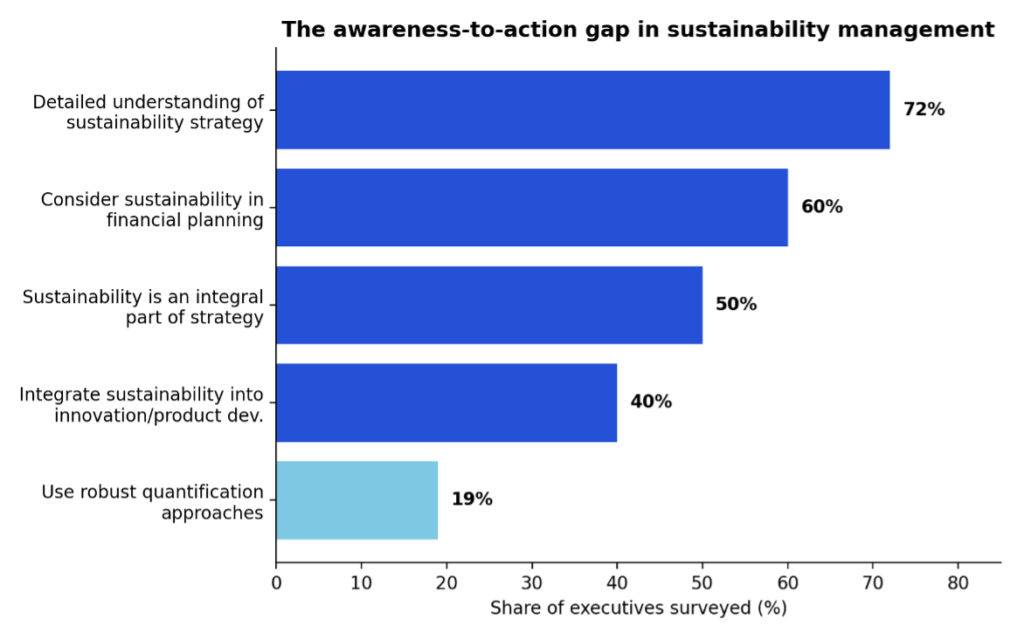
Figure 1. Executive awareness of sustainability consistently outpaces the ability to quantify its financial impact. Source: KPMG International, Closing the Sustainability Valuation Gap (2026).
This pattern echoes findings from the OECD’s work on green entrepreneurship, which notes that small and medium-sized enterprises — the backbone of most national economies — frequently possess awareness of environmental opportunity and regulatory direction of travel, but lack the business-case tools, dedicated financial instruments and technical skills needed to translate that awareness into investment decisions. The OECD’s own diagnostic work, including its pilot dashboard of SME greening indicators, was created precisely to address this measurement vacuum, on the premise that what cannot be measured cannot be financed, scaled or defended in a boardroom.
3. Policy as Catalyst: The European Regulatory Effect
3.1 Building an Ecosystem of Mandatory Disclosure
If awareness alone were sufficient, sustainability integration would already be consistent across markets. However, this is not the case, and regulation is the most significant explanatory factor in the KPMG data. The European Union’s Green Deal strategy, which aims for climate neutrality by 2050 and channels capital towards sustainable initiatives, is supported by a comprehensive regulatory framework that includes sustainable finance taxonomy, corporate due diligence, carbon pricing, tax incentives, and the Corporate Sustainability Reporting Directive. Simon Weaver, KPMG’s Global Head of Sustainability Advisory, notes that frameworks like the Task Force on Climate-related Financial Disclosures, the International Sustainability Standards Board’s standards, and the CSRD effectively operate as strategic risk management tools. They require companies and investors to articulate sustainability-related risks within the context of enterprise strategy and financial planning, even though they may sometimes feel more like compliance exercises than integral components of daily decision-making.
3.2 A Transatlantic Contrast
The behavioural effect of this regulatory density is visible in the data. Around two-thirds of executives in Italy (64 percent) describe sustainability as integral to strategy, a proportion matched closely by Spain and France (61 percent each). This contrasts sharply with the United States, where only one-third of executives (34 percent) say the same, and with Canada, Korea and Japan, where fewer than half do. India offers an instructive parallel case outside Europe: India’s mandatory Business Responsibility and Sustainability Reporting (BRSR) regime forces its largest 1,000 listed companies to disclose sustainability performance systematically. This regulatory compulsion, similar to Europe’s effect, pushes executives to engage closely with sustainability metrics and strategy — producing higher detailed understanding (43 percent) than in less-regulated markets like the US, Japan, or China.
4. Cross-National and Cross-Sectoral Gaps in Sustainable Management
4.1 The Geography of Readiness
Regulatory maturity is only one axis of variation. KPMG’s country-level data reveals a wide spread in the proportion of executives who regard sustainability as integral to their strategy, ranging from 67 percent in South Africa to 34 percent in the United States. These gaps matter for entrepreneurship and multinational strategy alike: a venture or investor operating across this spread must account for materially different levels of sustainability-linked institutional readiness, regulatory scrutiny and stakeholder expectation in each market it enters — a dynamic the OECD has also documented in its comparative reviews of SME greening policy, which find that green entrepreneurship support, access to finance and skills development vary substantially even among high-income economies.
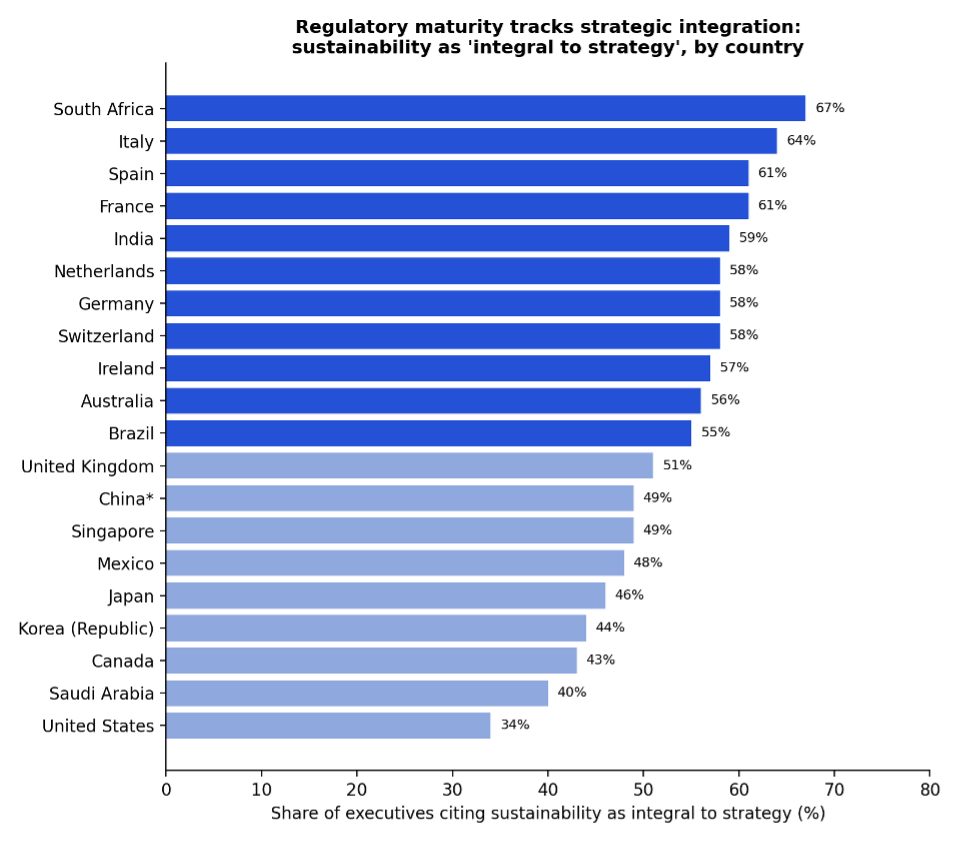
Figure 2. Share of executives describing sustainability as an integral part of their company’s strategy, by country. Source: KPMG International (2026).
4.2 Sectoral Divergence: Capital Intensity as a Driver
A second and arguably sharper divide runs across sectors. Banking and capital markets (33 percent), energy, natural resources and chemicals (31 percent), and automotive (27 percent) lead in the adoption of robust valuation methodologies, while industrial manufacturing, healthcare, private equity and infrastructure lag at 12–13 percent. KPMG’s Global Head of Financial Services, Karim Haji, and Global Head of Energy, Anish De, attribute this to the directness with which climate transition, carbon pricing and stranded-asset risk shape the financial fundamentals of capital-intensive sectors — banks must already stress-test portfolios for credit and capital-adequacy risk, while energy and automotive companies have long modelled commodity-price scenarios into capital expenditure decisions. Sectors where sustainability is less tightly coupled to near-term financial performance have correspondingly weaker incentives to invest in sophisticated valuation tools, even though the cost of inaction accrues regardless of sector.
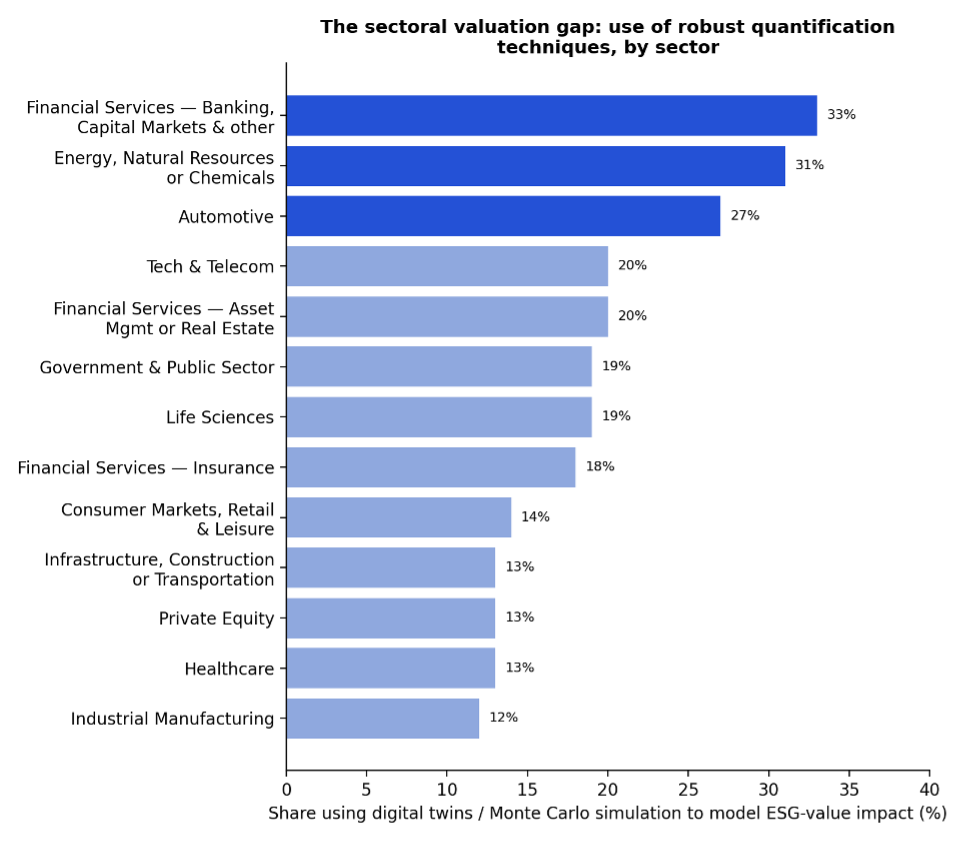
Figure 3. Share of executives applying robust quantification techniques (e.g., digital twins, Monte Carlo simulation) to sustainability’s impact on value creation, by sector. Source: KPMG International (2026).
This sectoral unevenness is consistent with the London Sustainable Development Commission’s Green Means Business report, which found London’s green economy — then worth an estimated £25 billion and growing faster than the wider city economy — to be concentrated in specific clusters such as clean technology, green finance and environmental professional services, rather than evenly distributed across the business base. The Commission’s recommendation of an explicit sectoral growth ambition for green business reflected an early recognition that sustainable value creation clusters around sectors with the technical capability, capital access and market incentive to capture it — precisely the pattern KPMG’s more recent global data now confirms at scale.
5. From Risk Mitigation to Reputation: Sustainability as a Brand Asset
5.1 Brand as the Visible Face of Invisible Capital
This finding aligns with the Deloitte UK green skills agenda, developed with the Institute of Environmental Management and Assessment, which observes that organisations in sectors such as luxury goods and technology have already recognised the competitive advantage of environmentally credible business models, and are increasingly elevating sustainability expertise to executive and board level. A brand’s sustainability credentials function as a visible proxy for capabilities that are otherwise difficult for customers, investors and talent to observe directly — supply chain resilience, regulatory foresight, operational efficiency and long-term strategic discipline. Where that credibility is backed by investment-grade, quantified data rather than aspirational messaging, it becomes durable brand equity; where it is not, it is vulnerable to greenwashing scrutiny and the reputational and legal costs that follow. KPMG’s own research underscores this: European capital markets are already reallocating away from businesses that cannot demonstrate resilience against sustainability-related risk, with at least one major European bank divesting from dozens of companies on this basis.
5.2 Embedding Sustainability into Entrepreneurial DNA
For entrepreneurial ventures specifically, the OECD’s green entrepreneurship research and the London Sustainable Development Commission’s earlier scoping work on green entrepreneurship both emphasise that sustainability-oriented start-ups and SMEs are disproportionate sources of the very innovations — circular business models, resource-efficient technologies, low-carbon products — that establish new categories of brand differentiation. But both bodies of work also stress that entrepreneurs face acute barriers: complexity in building the business case, limited access to green finance, and gaps in green skills and awareness. Deloitte’s blueprint for green workforce transformation similarly finds that embedding sustainability durably into an organisation requires tailored skills and behaviours at every level and seniority, not just a single sustainability function bolted onto the business. The implication for founders, accelerators and foundations supporting entrepreneurship is that sustainability should be designed into a venture’s value proposition, governance and brand narrative from inception, rather than retrofitted once scale or investor scrutiny demands it.
6. Conclusion: Toward a Common Language of Value
The evidence assembled here — from KPMG’s global executive survey, the OECD’s diagnostic work on green entrepreneurship, Deloitte’s green skills research and the London Sustainable Development Commission’s pioneering city-level analysis — converges on a single conclusion. Sustainability is no longer contested as a legitimate business concern; what remains unresolved is the absence of a common, credible methodology for translating sustainability-related risks and opportunities into the language of enterprise value, capital allocation and brand equity. Closing that valuation gap is not merely a technical exercise for finance teams. It is, increasingly, the precondition for sustainability to move from the margins of corporate reporting to the centre of business strategy, management education and entrepreneurial practice — and for organisations, investors and policymakers alike to treat sustainable value creation not as an act of goodwill, but as a rigorously defensible source of competitive advantage.
References:
- Closing the sustainability valuation gap
- Green Entrepreneurship | OECD
- Green skills for the green economy | Report | Deloitte UK
- lsdc_-_green_means_business_report_2014.pdf
Dr Bidit L. Dey

