


The modern world is defined by human movement. More people than ever before have travelled across borders for work, education, or pleasure. The two main forms of this movement—migration and tourism—represent distinct aspects of the same worldwide phenomenon. While migration refers to a longer-term relocation, frequently driven by work or family, tourism refers to short-term travel for pleasure or business. However, these two processes are always interacting in real life. While migrants frequently become tourists or draw friends and family to visit them, visitors may choose to settle in a particular location. Both economic policy and sustainable territorial development depend on an understanding of these relationships.
According to the World Tourism Organization (UNWTO), international tourist arrivals reached 1.5 billion in 2019 before the pandemic and recovered to around 1.3 billion in 2023 (World Tourism Organization, 2024). In parallel, the International Organization for Migration (IOM) estimates that the number of international migrants rose from around 85 million in 1970 to 281 million in 2020, representing 3.6 % of the world’s population (International Organization for Migration, 2024). These two massive flows, both rooted in globalization, have become intertwined through labour markets, investment, and cultural exchange. However, traditional research long treated them as separate spheres: tourism as consumption, migration as production.
A turning point came with the work of Allan M. Williams and C. Michael Hall (2000), who argued that tourism and migration belong to a single “continuum of mobility” ranging from short-term travel to long-term residence. Later, the World Tourism Organization (2009) formalized this view by distinguishing two directions of causality: Migration-Led Tourism (MLT), when migrant networks generate tourist flows, and Tourism-Led Migration (TLM), when tourism development attracts migrants for work or lifestyle reasons.
This article therefore asks: How do tourism and migration influence each other, and under what conditions can this interaction foster inclusive and sustainable development?
The following parts examine the theoretical and economic interdependence between the two mobilities.
Conceptual framework and evolution of mobilities
Tourism and migration are commonly defined by different temporalities. Tourism is generally defined as the activity of persons travelling and staying outside their usual environment for less than one consecutive year for leisure, business, or other non-remunerated purposes. Migration, by contrast, is characterized by a change of residence for a longer period, generally exceeding one year. Yet the boundary between the two has blurred. Advances in transport, digital communication, and global labour integration have created new forms of mobility that do not fit neatly into either category.
Williams and Hall (2000) proposed that human movement exists along a continuum. Between the tourist and the migrant are intermediate profiles such as seasonal workers who circulate with tourism demand, retired people who settle in regions they once visited, and entrepreneurs who return to their homeland to invest in hospitality. More recently, the rise of digital nomads —professionals who work online while travelling—illustrates how technology enables hybrid lifestyles combining work and travel. These examples demonstrate that the distinction between temporary and permanent mobility has become more functional than factual.
This conceptual evolution also reflects deeper social transformations. Globalization has made mobility a normal condition of life rather than an exception. Cheaper air travel and liberalized visa regimes have expanded short-term tourism, while demographic aging and flexible labour markets have encouraged migration and transnational commuting. Both phenomena respond to similar drivers: economic opportunity, lifestyle aspirations, and the search for cultural experience. They are therefore not opposite but mutually embedded.
Economic interdependence and reciprocal effects
The economic links between tourism and migration operate in both directions. Migration stimulates tourism, while tourism generates migration. The World Tourism Organization (2009) estimates that nearly 27 % of international travel is motivated by visiting friends and relatives, religious practice, or health—activities directly related to migrant networks. In many countries of emigration, between 15 % and 25 % of total tourist arrivals are attributable to diaspora visitors (i.e. migration-driven). This Migration-Led Tourism provides stable, counter-seasonal demand and supports small businesses in hospitality and transport. It also promotes emotional and financial ties between migrants and their places of origin.
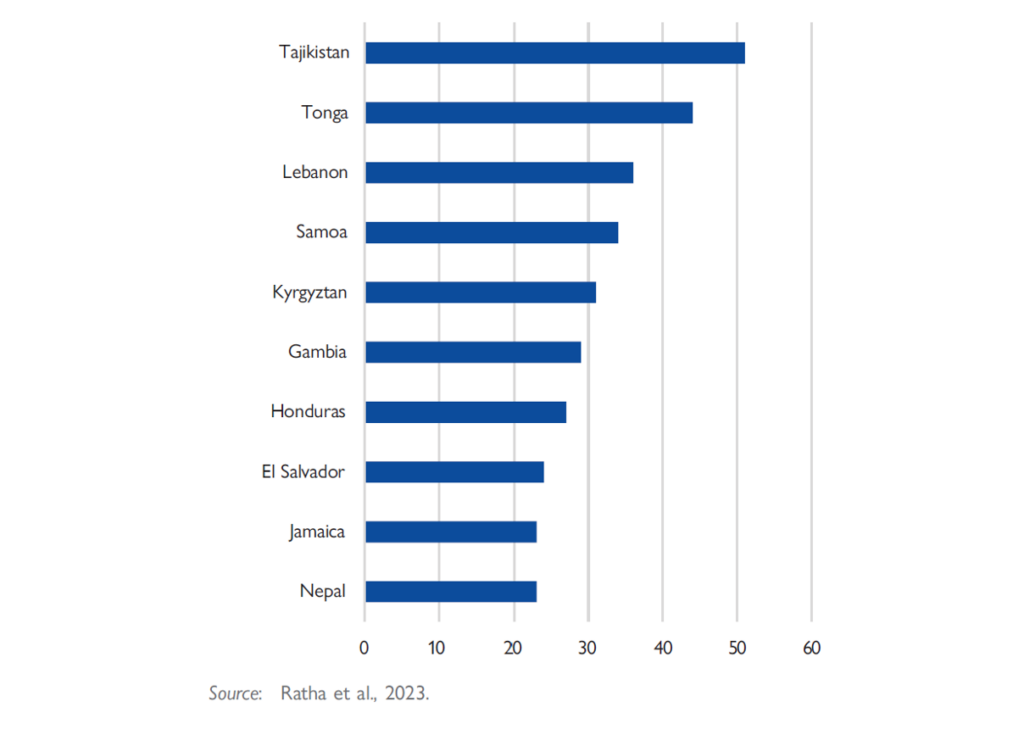
Remittances amplify these effects. In 2022, global remittances reached about 831 billion USD (International Organization for Migration, 2024), exceeding foreign direct investment in several developing regions. A portion of these funds is reinvested in tourism enterprises such as guesthouses, restaurants, and travel agencies. In this way, migration transfers not only people but also capital and entrepreneurial knowledge that sustain local tourism industries.
Figure 1: Top 10 recipient countries of international remittances by share of GDP, 2022
Conversely, tourism development can initiate or reinforce migration. Growing destinations often face labour shortages, especially in hotels, restaurants, and construction. Migrant workers fill these gaps, ensuring the functioning of tourism economies. This Tourism-Led Migration also includes lifestyle and retirement migration: individuals who, after repeated visits, decide to live permanently in attractive destinations. For instance, many northern Europeans have relocated to Mediterranean regions such as Spain, Portugal, or Italy, drawn by climate and culture.
From a macroeconomic perspective, tourism receipts and remittances form two sides of the same coin. International tourism exports generated 1.8 trillion USD of revenues in 2023, equivalent to 23% of the world’s trade in services and about 6% of overall exports of goods and services (World Tourism Organization, 2024). Together with remittances, these flows constitute a circular exchange of income between sending and receiving countries. As UNWTO observes, their impacts on local development are often complementary and sometimes indistinguishable. Tourism creates jobs that attract migrants; migration in turn produces tourists and investors. The two sectors thus reinforce one another within a global system of mobility.
Figure 2: World’s Top 10 export categories by earnings (USD trillions), 2019 and 2022
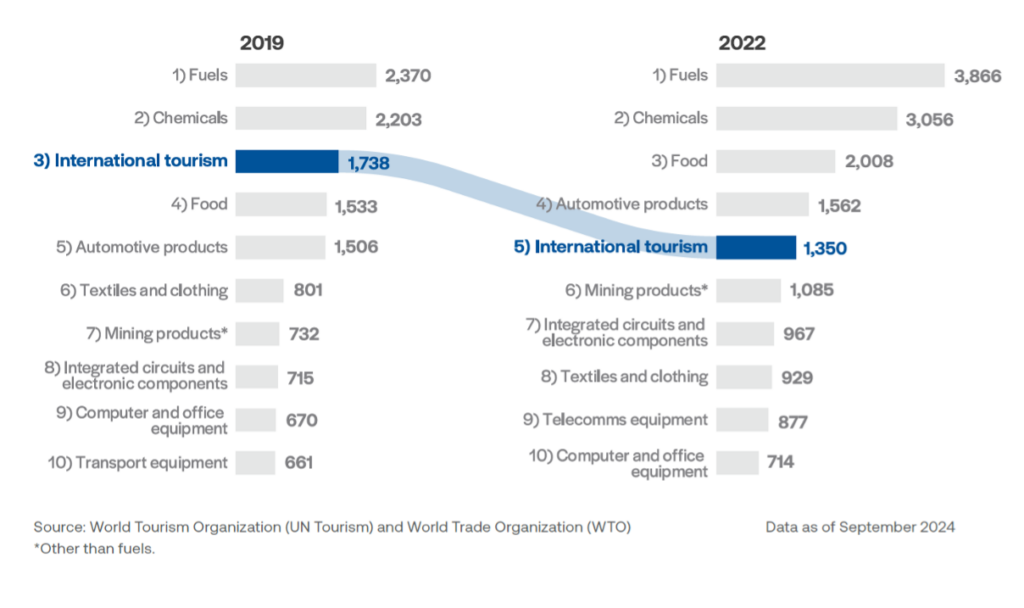
As shown in Figure 2, In 2022, tourism ranked as the world’s fifth-largest export category, after fuels (first), chemicals (second), food (third) and automobiles (fourth). Prior to the coronavirus epidemic in 2019, tourism ranked as the third-largest export.
Conclusion
Tourism and migration are no longer separate realities but interconnected dimensions of the same global system of human mobility. Tourism relies on the labour, creativity, and networks of migrants, while migration generates visitors, investment, and cultural exchange. Together they constitute a circular process in which people, capital, and ideas circulate between origin and destination societies.
Theoretical research by Williams and Hall (2000) demonstrated that tourism and migration exist along a continuum of mobility, while the World Tourism Organization conceptualized their relationship through Migration-Led Tourism and Tourism-Led Migration.
Yet sustainability depends on continuous vigilance. Reliable data collection, fair working conditions, and accessible housing remain essential to prevent inequality or over-tourism. The future will bring new hybrid mobilities—students, retirees, and digital nomads—that will blur boundaries even further. Managing these flows ethically and intelligently will ensure that movement remains a force for prosperity and mutual understanding rather than division.
In sum, tourism and migration are two faces of a single human journey: both express the desire to explore, to improve, and to connect. When guided by sound policy and social inclusion, their interaction can become one of the most constructive dimensions of globalization.
References
- McAuliffe, M. and L.A. Oucho (eds.), 2024. World Migration Report 2024. International Organization for Migration (IOM), Geneva.
- Ratha, D., S. Plaza, E.J. Kim., V. Chandra., N. Kurasha and B. Pradhan (2023). Remittances Remain Resilient but Are Slowing. Migration and Development Brief 38. June. KNOMAD–World Bank, Washington, D.C.
- Williams, A. M., & Hall, C. M. (2000). Tourism and migration: new relationships between production and consumption. Tourism geographies, 2(1), 5-27.
- World Tourism Organization (2024), International Tourism Highlights, 2024 Edition, November 2024, UN Tourism, Madrid, DOI: https://doi.org/10.18111/9789284425808.
- World Tourism Organization (2009), Tourism and migration: Exploring the relationship between two global phenomena. World Tourism Organization.

