



Companies love stars. Retailers promote their top salespeople. Consulting companies put their biggest names on important projects. Business schools deploy their top-notch professors to teach at the executive level. And all of that because they assume that yesterday’s winner is the safest person to trust their organization’s fate tomorrow. At first glance, these choices make sense because past success is visible, easy to compare, and easy to justify.
The National Basketball Association (NBA) does all of this in public. However, unlike most workplaces out there, it also records almost everything. NBA is the league where performance (stats), salaries, team results, promotions, status, and what happens immediately after success or failure are public. That makes professional basketball an unusually useful experiment to test core management theories and beliefs. In this article, I reflect on three recent studies using NBA data to challenge some of the most common assumptions organizations make about talent. The message I derive from this screening is quite uncomfortable. Why? Well, the best performer may not be the best leader, high status can reduce the reward from good performance, and success can sometimes make people perform worse.
Why the NBA is appropriate to test management theories
The NBA is obviously neither a normal office nor a typical organization. Players are elite athletes, performance is unusually visible, and the stakes of failure are extreme. That is precisely what makes it useful. In many organizations, it is difficult to separate individual performance from team performance, status, reputation, or luck. In the NBA, those variables are much clearer. Schleu et al. (2026), for example, analyze the career histories of 329 NBA head coaches. Wang (2025) links player performance, status, salaries, and ratings. Bühren and Krabel (2021) use play-by-play data to study what happens immediately after decisive success and failure. Together, these studies let us test three management beliefs common far beyond sport.
Myth 1: The best performer is the obvious person to promote
Organizations frequently promote people because they outcompete their peers in their current role. The star analyst becomes team leader. The best engineer becomes engineering manager. The strongest salesperson becomes sales director. The hidden assumption behind such a promotion decision is that excellence at doing a job predicts excellence at leading others who do it.
Evidence from the NBA suggests that this assertion deserves much more scrutiny. Schleu et al. (2026) find only a weak link between prior player performance and subsequent coaching performance, and that weak relationship remains consistent over time. In their main analysis, the standardized association is about 0.13 (see Figure 1 below). Simply having played in the NBA before becoming a coach is an even weaker signal of later coaching performance.
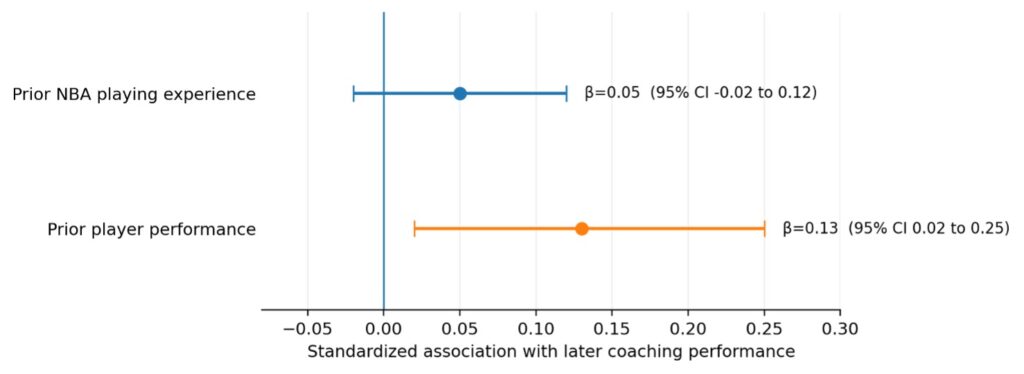
Figure 1. Playing success is only a weak signal of future coaching performance. Source: Author visualisation based on Schleu et al. (2026).
This makes more sense once we separate the jobs. A player succeeds through shooting, movement, physical execution, and tactical awareness. A head coach must select and develop people, design strategy, manage personalities, communicate under pressure, and balance short-term results with long-term development. Some knowledge transfers, but much of the job does not.
The organizational lesson from this finding is not to stop promoting high performers. It is to stop treating current performance as a substitute for evidence about the next job. Promotion should ask a future-facing question: what does this person need to be good at next?
Myth 2: Status always makes success more valuable
We normally think of status as a big advantage for an individual. It brings visibility, credibility, better opportunities, and negotiating power. Yet status also creates something less obvious. This is the expectations the organization (team) has of the employee (player).
Wang (2025) studies NBA players and shows that high-status players benefit less from additional performance than lower-status players. Importantly, this does not mean stars are paid less overall. It means the reward attached to another unit of strong performance shrinks as status rises. The same pattern appears when employees work with prestigious teammates: strong team performance translates into less individual benefit when high-status colleagues are present.
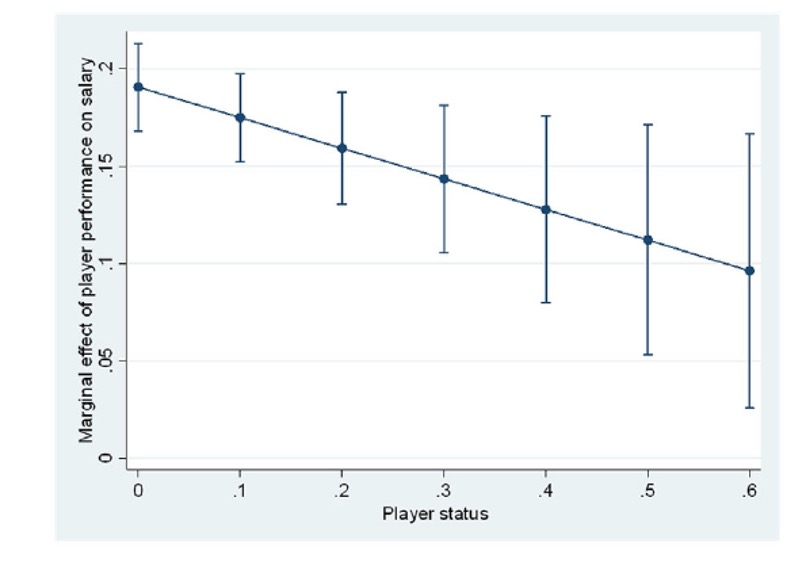
Figure 2. The higher your status, the smaller the additional reward from performing better.
The marginal effect of individual player performance on salary declines as NBA player status increases (2025). Source: Wang (2025), Figure 1. Reproduced from the open-access article under CC BY.
Why? Because performance is judged against expectations. A relatively unknown employee who delivers an excellent result can dramatically exceed expectations. On the other hand, a recognized star may deliver the same result and hear, in effect, ‘that is what we expected from you.’ Wang describes this as a possible reverse Matthew effect: status can become a burden because the bar rises with it. Figure 2 shows how status changes the reward for performance. Better individual performance is associated with higher salaries, but that additional payoff becomes progressively smaller as a player’s status increases. In other words, a strong performance produces a larger salary benefit for a relatively low-status player than for an established star.
This is easy to recognise outside basketball. A junior employee who lands a major client may become the story of the quarter. A celebrated rainmaker landing the same client may simply be doing their job. A young academic publishing an outstanding paper may receive exceptional attention; an established professor may be expected to do so repeatedly. The lesson for managers is uncomfortable but practical: if performance systems are supposed to reward contribution, they need to distinguish contribution from expectations created by reputation.
Myth 3: Back the winner and bench the person who failed
Perhaps the most striking evidence concerns what happens immediately after a high-pressure success or failure. Bühren and Krabel (2021) examine ten NBA seasons and isolate players who personally created overtime in the final seconds of regulation. One group scored the tying shot: a crucial success. Another missed a potential game-winning shot while the score was tied: a crucial failure.
What happened next runs against the usual idea of momentum. After making the tying shot, players’ field-goal percentage fell by about 12.1 percentage points from the fourth quarter to overtime. After missing the potential winner, field-goal percentage rose by about 10.1 points (see Figure 3 below). The authors’ broader performance measure also shows a meaningful deterioration after crucial success. Failure improved relative to the previous quarter, but not to the player’s normal average.
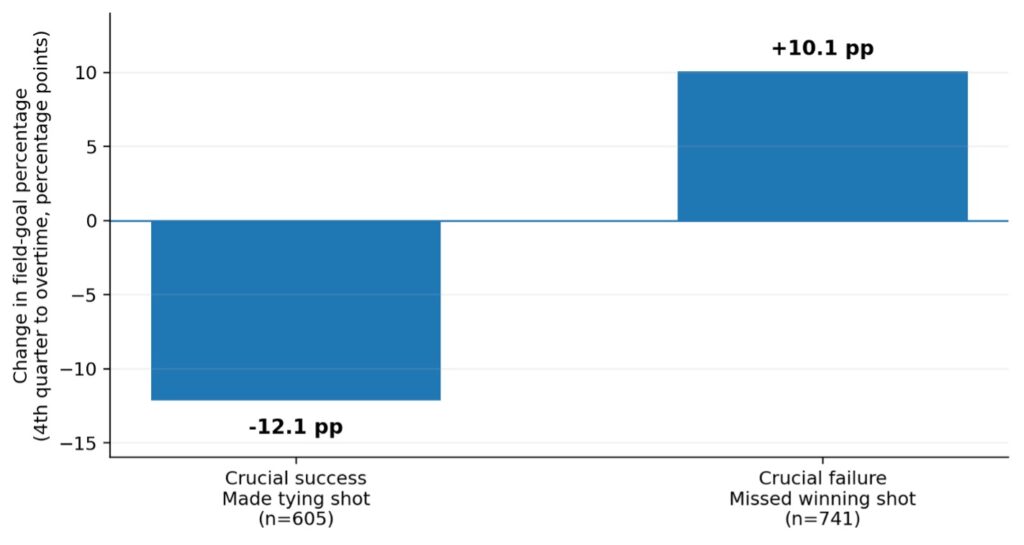
Figure 3. Immediately after a crucial success or failure, shooting performance moved in opposite directions. Source: Author visualisation based on Bühren and Krabel (2021).
The proposed explanation is especially relevant to other types of workplaces. Success may increase confidence enough to encourage riskier behavior or reduced discipline. In the NBA data, players coming off crucial success took more shots and attempted them from farther away. Failure, by contrast, may trigger additional effort and correction.
What should managers take from this?
These studies do not prove that every workplace behaves like an NBA team. The authors of these three studies are careful about the limits of generalization. But the NBA gives us something organizations rarely possess. Repeated, visible, and relatively objective measures of performance under pressure.
Across the three studies, one common denominator applies. Organizations like to use shortcuts. They use past performance to infer leadership potential, status to interpret how impressive a result is, and recent success or failure to predict what someone will do next. Those shortcuts may be convenient, but they are not always reliable.
A better approach is to evaluate people against the requirements of the role they are about to perform, separate reputation from actual contribution, and resist making the next assignment purely based on the emotions of the previous result.
References
- Bühren, C., & Krabel, S. (2021). Human performance after success and failure: Evidence from the NBA. The International Journal of Human Resource Management, 32(16), 3402–3427. https://doi.org/10.1080/09585192.2019.1634121
- Schleu, J. E., Klasmeier, K. N., Mazei, J., & Hüffmeier, J. (2026). From star player to star coach? The longitudinal validity of performance-based promotion in the National Basketball Association. Journal of Management Scientific Reports, 4(3), 333–363. https://doi.org/10.1177/27550311261438046
- Wang, P. (2025). Employee status, role expectation and performance evaluation: Evidence from NBA players. British Journal of Management, 36, 1132–1145. https://doi.org/10.1111/1467-8551.12890
George Batsakis

