



Executive Summary
Dementia is one of the most significant health and social care challenges facing the UK, affecting approximately 982,000 people and projected to impact more than 1.4 million by 2040. Beyond its human consequences, dementia imposes a substantial economic burden, currently estimated at £42.5 billion annually and expected to exceed £90 billion by 2040. Much of this cost is borne by families through unpaid care, highlighting the growing pressure on informal carers and support systems.
A particularly important but often overlooked issue is the financial independence of people living with dementia. Cognitive decline can impair an individual’s ability to manage finances, increasing vulnerability to fraud, exploitation, financial abuse, and exclusion. At the same time, maintaining control over personal finances is closely linked to autonomy, dignity, identity, and quality of life. Existing safeguarding approaches frequently rely on carers assuming direct financial control, creating tensions between protection and independence.
Technology-mediated interventions offer promising solutions. Digital tools can monitor financial activities, detect unusual transactions, identify potential scams, and provide timely alerts, helping individuals maintain independence while reducing caregiver burden. However, the article argues that technology should not be viewed as a panacea. Successful innovation requires co-creation involving people living with dementia, carers, healthcare professionals, financial institutions, policymakers, and technology developers. Drawing on Arnstein’s Ladder of Citizen Participation, the article emphasises that solutions designed through top-down approaches are unlikely to achieve sustained adoption, trust, or effectiveness.
The article concludes that future policy and innovation should prioritise co-design, supported autonomy, ethical governance, legal safeguards, accessibility, and cross-sector collaboration. Technology can become a powerful enabler of financial security and independent living only when it is developed with people rather than for them.
Introduction:
Dementia is one of the most pressing public health and social care challenges facing the United Kingdom. An estimated 982,000 people are currently living with dementia, and this figure is projected to exceed 1.4 million by 2040. Despite its growing prevalence, more than one-third of those affected remain without a formal diagnosis, limiting access to timely support, treatment, and care. Dementia is now the leading cause of death in the UK, responsible for 76,894 deaths in 2024, representing 11.8% of all deaths nationwide. The burden is particularly significant among women, with 48,915 female deaths compared with 27,979 among men. Across the nations of the UK, England reports the highest dementia-related mortality rate (12%), followed by Northern Ireland (11.1%), Wales (11%), and Scotland (10.6%).
Beyond its devastating human impact, dementia places immense pressure on families, health services, and the wider economy. The annual economic cost is estimated at £42 billion, with families shouldering approximately 63% of overall care expenses. In England alone, around 169,500 people with a formal dementia diagnosis reside in care homes. As populations age, these pressures are expected to intensify, creating an urgent need for innovative and scalable solutions.
Technology-mediated interventions hold great potential in addressing the challenges presented by dementia. Recent advancements in digital health, artificial intelligence, remote monitoring, assistive technologies, and financial safeguarding tools can facilitate earlier diagnosis, enhance independence, alleviate caregiver burden, and improve the overall quality of life for individuals living with dementia. It is essential to harness technology in a responsible and inclusive manner to develop sustainable solutions for one of the UK’s rapidly growing health and social care issues. This article focuses specifically on technology-mediated support aimed at ensuring the financial safeguarding and independence of dementia patients. Before exploring the importance and challenges of such measures, it is pertinent to consider the financial implications of dementia.
Cost of dementia:
Dementia is not only a major health and social care challenge but also one of the most costly medical conditions facing the UK. According to the Dementia Statistics Hub, the estimated economic impact of dementia reached approximately £42.5 billion in 2024 and is projected to more than double to over £90 billion by 2040, reflecting the growing prevalence of the condition and the increasing demands placed on health and care systems.
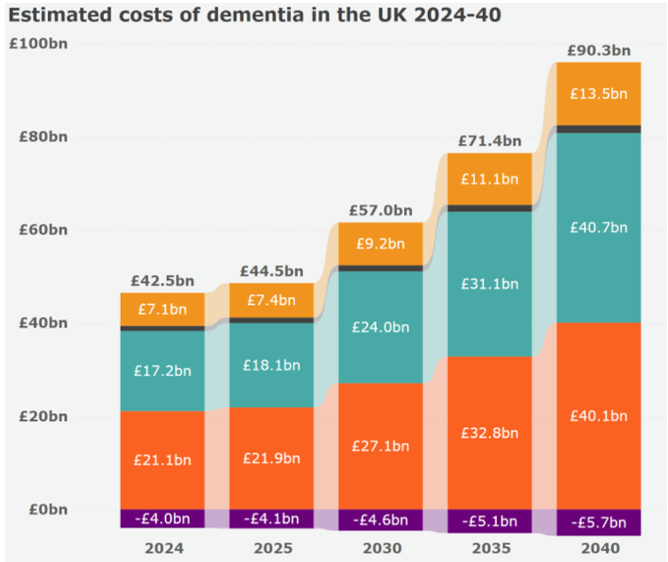
Figure 1: Estimated costs of dementia in the UK 2024-2040; source: The economic impact of dementia – Dementia Statistics Hub
A striking feature of dementia’s economic burden is that much of the cost falls outside formal healthcare services. Unpaid care provided by family members and friends accounts for around half of the total economic impact, while social care contributes a further 40%, highlighting the crucial yet often overlooked role of informal caregivers. In 2024, the estimated value of unpaid care alone was approximately £21.1 billion, demonstrating how heavily the UK relies on families to support people living with dementia.
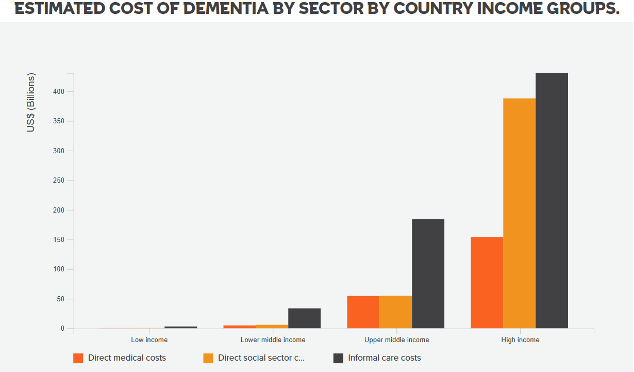
The scale of this burden is substantial. In England, an estimated 461 million hours of unpaid care were provided to people living with dementia, illustrating the significant personal, financial, and emotional costs experienced by caregivers. Beyond the UK, dementia presents a growing global economic challenge, with worldwide costs estimated at US$1.3 trillion and expected to rise sharply as populations age.
These figures underline the urgent need for innovative interventions, policy action, and technology-enabled solutions that can support people living with dementia, reduce pressures on families, and improve the sustainability of health and social care systems.
Financial safeguarding and independence for people living with dementia
Financial independence is a fundamental component of living well with dementia, yet it is increasingly threatened as cognitive decline affects memory, judgement, and decision-making. Everyday financial activities such as paying bills, monitoring accounts, recognising suspicious transactions, and making informed spending choices can become progressively more challenging, leaving individuals vulnerable to financial mistakes, scams, exploitation, and social exclusion. At the same time, the ability to manage one’s own finances is closely tied to personal autonomy, dignity, identity, and quality of life.
The importance of financial safeguarding is heightened by evidence that people living with dementia face a disproportionately high risk of financial abuse. Estimates suggest that between 10% and 20% of older adults with cognitive impairment experience some form of financial exploitation, although many incidents go undetected or unreported. Existing safeguarding mechanisms often rely on family members or carers taking direct control of financial affairs, which can create difficult tensions between ensuring protection and preserving an individual’s privacy, independence, and sense of self-respect. Moreover, research indicates that a significant proportion of substantiated financial abuse cases involve trusted individuals within existing care or family networks, underscoring the limitations of approaches that depend solely on personal oversight.
These challenges highlight the need for innovative solutions that can strengthen financial security without unnecessarily compromising independence. Effective financial safeguarding should not be viewed merely as protection from harm, but as a means of enabling people with dementia to maintain control, confidence, and participation in everyday life for as long as possible.
The need for effective financial safeguarding is becoming increasingly urgent as dementia prevalence continues to rise across the UK. As mentioned earlier, dementia already imposes an estimated economic burden of £42.5 billion annually, a figure projected to exceed £90 billion by 2040. Unpaid care alone accounts for approximately £21.1 billion of annual costs and represents around half of the total economic impact of dementia. Millions of hours of unpaid care are provided by relatives and friends, who frequently assume responsibility for managing the finances of affected individuals alongside other caregiving duties.
Technology-mediated interventions offer significant opportunities to address these challenges. Digital financial safeguarding tools can help detect unusual spending patterns, identify potential scams, provide timely alerts to trusted carers, and support individuals in maintaining independence for longer. Such technologies can reduce caregiver burden while empowering people with dementia to participate safely in financial decision-making. As dementia rates continue to increase and families shoulder a substantial proportion of care responsibilities, investing in technology-enabled financial independence and safeguarding solutions is not merely desirable but essential for promoting dignity, security, and sustainable care outcomes.
Is technology a panacea?
While technology-mediated interventions hold considerable promise for supporting financial independence and safeguarding people living with dementia, it would be misguided to regard technology as a panacea. Too often, digital solutions are designed through a top-down process in which technologies are developed by experts, implemented by organisations, and subsequently imposed on users whose lived experiences have had little influence on their design. Such approaches frequently fail because they prioritise technical functionality over the complex social, emotional, ethical, and contextual realities of everyday life with dementia.
Arnstein’s Ladder of Citizen Participation provides a useful lens for understanding this challenge. The framework distinguishes between tokenistic forms of consultation and genuine citizen power, in which affected individuals actively shape decisions that affect their lives. In the context of dementia, meaningful innovation requires moving beyond merely asking people living with dementia to test technologies after development. Instead, they should be recognised as experts in their own lived experiences and involved as co-creators throughout the design, development, implementation, and evaluation process. Equally important is the participation of family carers, financial institutions, healthcare professionals, charities, social care providers, regulators, and technology developers, whose diverse perspectives can help ensure solutions are practical, acceptable, and trustworthy.
The importance of such collaboration extends beyond usability. Financial safeguarding technologies inevitably raise questions concerning privacy, consent, data protection, autonomy, algorithmic bias, and accountability. A system designed solely to maximise protection may inadvertently undermine independence and dignity, while excessive emphasis on autonomy may expose individuals to unacceptable risks. Only through ongoing dialogue and co-production can these competing priorities be balanced appropriately.
Ultimately, technology should be viewed not as a substitute for human-centred care, but as an enabling tool within a broader ecosystem of support. Sustainable and ethical innovation emerges when technologies are developed with people rather than for them, reflecting the principle that those most affected by a problem should have a meaningful voice in shaping its solutions.
Policy implications
For technology-mediated financial safeguarding tools to achieve both commercial success and meaningful social impact, policy frameworks must move beyond a purely technology-centric focus and place people living with dementia at their core. The following principles can help guide the development, deployment, and adoption of such solutions.
- Mandate Co-Design and Co-Creation
Public funding, procurement, and regulatory approval processes should require the active involvement of people living with dementia, carers, healthcare professionals, financial institutions, and advocacy organisations throughout the innovation lifecycle. Solutions developed without sustained user participation are unlikely to achieve long-term adoption or trust.
- Prioritise Supported Autonomy over Restrictive Control
Policy should encourage technologies that enable individuals to retain financial independence for as long as possible rather than automatically transferring control to carers or institutions. Tools should provide graduated levels of support, allowing intervention only when risks are detected.
- Establish Clear Ethical and Legal Safeguards
Developers should be required to demonstrate compliance with data protection, informed consent, explainability, cybersecurity, and transparency requirements. Users and families must understand how decisions are generated, what data are collected, and how information is shared.
- Promote Interoperability and Cross-Sector Collaboration
Financial safeguarding technologies should integrate seamlessly with banking systems, healthcare providers, social care organisations, and third-sector support networks. Fragmented solutions increase complexity and reduce effectiveness.
- Incentivise Inclusive and Accessible Design
Accessibility standards should ensure that interfaces accommodate varying levels of cognitive ability, digital literacy, sensory impairment, and cultural diversity. Simplicity and usability must be treated as strategic business priorities rather than technical afterthoughts.
- Develop Evidence-Based Evaluation Standards
Success should be measured not only by commercial performance or fraud prevention metrics but also by outcomes such as independence, dignity, confidence, user satisfaction, caregiver burden, and quality of life.
Ultimately, commercially viable dementia technologies will emerge not from top-down innovation alone, but from ecosystems that balance business sustainability with ethical responsibility, user empowerment, and genuine co-creation.
Conclusion
Dementia presents not only a profound health challenge but also a growing social and economic threat that affects individuals, families, communities, and public services. As the prevalence of dementia continues to rise, strengthening financial independence and safeguarding for those living with the condition will become increasingly important. Technology offers significant potential to support this goal by helping individuals manage finances more safely, reducing caregiver burden, and identifying risks before harm occurs. However, technology alone is not the answer. Lasting solutions require co-creation, ethical governance, legal safeguards, and meaningful participation from people living with dementia and those who support them. The future of dementia care lies not in replacing human judgement with technology, but in harnessing technology to enhance autonomy, dignity, inclusion, and quality of life. When designed with people rather than for them, technological innovation can become a powerful enabler of both financial security and independent living.
Bidit L. Dey

