



AI is shifting income from labour to capital across European regions. Evidence shows that
AI-intensive areas experience declines in the labour share, with medium- and high-skilled
workers facing wage compression. The findings highlight rising inequality risks and the need
for policy responses to ensure more inclusive gains from AI.
Capital and labour constitute the two pillars on which the economy is built and that reap the
benefits of the income produced. Historically a good rule of thumb has been that two thirds of
national income is acquired by workers through wages and the remaining third goes to reward
the capital through profits, dividends and royalties from intellectual property. In more recent
times, economists have tracked a quiet but consequential shift in advanced economies: a
growing share of national income is flowing to capital, and a shrinking share to labour. This
trend, known as the decline in the labour share, predates artificial intelligence, but new
evidence suggests that AI may be accelerating it — and doing so in ways that challenge our
assumptions about who wins and who loses from technological change.
Since the 1980s, that stability of the labour share of income has eroded. Across advanced
economies, labour’s share has declined, while capital’s share has risen. Globalisation, weaker
union power, the falling price of investment goods, and capital-intensive technologies have
all been accused of this shift. The latest of the alleged culprits is artificial intelligence, which
appears to be reinforcing this shift.
A recent article by Antonio Minniti and coauthors explores exactly this phenomenon studying
238 European regions between 2000 and 2017 and finds a robust negative relationship
between AI-related innovation and the labour share of income.
Regions that specialise more heavily in AI patenting tend to experience sharper declines in
the share of income going to workers. A doubling of AI patent intensity is associated with a
reduction in the labour share of between 0.5% and 1.6%. That may sound modest, but
aggregated across regions and over time, it is economically meaningful.
As one can see Figure 1, this pattern is quite striking. The left panel shows regional AI
intensity across Europe, measured by technological specialisation in AI patents. The right
panel shows cumulative changes in the labour share between 2000 and 2017. The darker the
region in AI intensity, the more likely it is to have seen a decline in labour’s share. The
geographic overlap is hard to ignore.
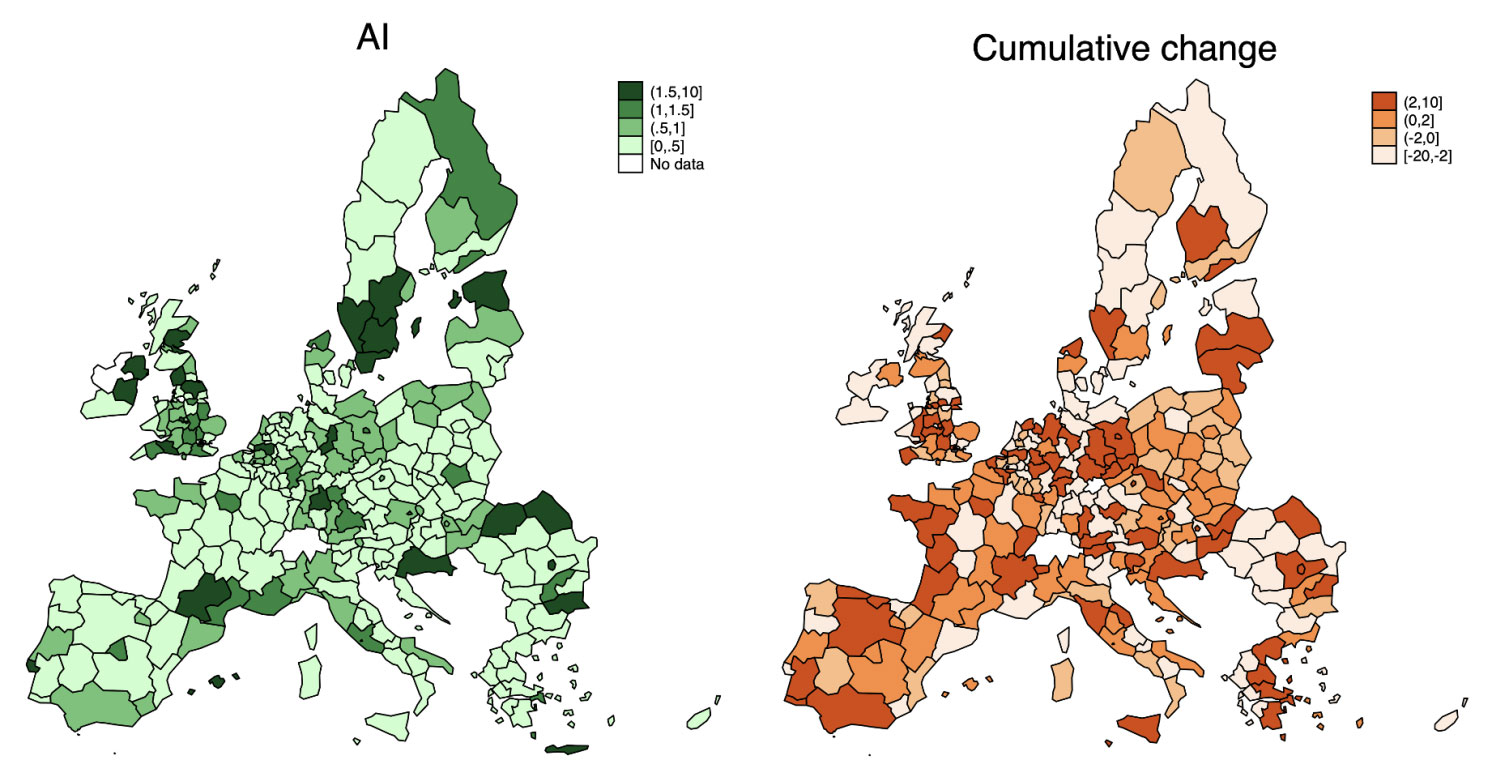 Figure 1. Regional AI patent intensity (left) and cumulative change in labour share 2000-
2017 (right). Source: Minniti et al. (2025).
Why would AI shift income away from labour? AI can be defined as a capital-biased
innovation, i.e. an innovation that disproportionately reward capital as opposed to labour.
More precisely, technological change can be labour-augmenting (raising workers’
productivity and therefore wages), capital-augmenting (raising the productivity of capital,
therefore profits), or labour-replacing (substituting machines for workers). AI appears to
combine capital-augmenting and labour-replacing features.
Unlike earlier waves of automation that focused on routine manual tasks, AI increasingly
performs cognitive functions: prediction, classification, optimisation, and even elements of
decision-making. These were once considered reserved to skilled professionals. As AI
systems increase their place in companies, firms can generate more output with fewer human
inputs — or at least without raising wages proportionately. If productivity gains accrue
disproportionately to owners of algorithms, data, and intellectual property, the capital share
rises.
The European evidence provided by Minniti et al. (2025) supports this mechanism. The
authors construct a region-level dataset, combining OECD patent data with Eurostat regional
accounts. Using detailed regional data on patents, wages, employment, capital stocks, and
productivity, the authors estimate dynamic panel regressions that link AI patent stocks per
worker to changes in the labour share. Importantly, they control for other forms of innovation
(including ICT and Fourth Industrial Revolution technologies), fixed capital accumulation,
R&D spending, productivity growth, industrial structure, and also demographic factors and
institutional quality. The negative effect of AI persists across specifications even after
controlling for all these confounders.
AI innovation is measured through specifically identified AI-related patent classes (e.g.,
machine learning, neural networks, natural language processing). Capital stocks are built
using perpetual inventory methods. The econometric model is quite sophisticated, as it is able
to disentangle short-run fluctuations from long-run relationships and account for spatial
(geographic) dependence, i.e. the possibility that neighbouring regions influence one another
and test the robustness of results to alternative depreciation rates, alternative productivity
measures, and different transformations of the patent data. Across these exercises, the core
finding remains: AI innovation is associated with a decline in labour’s share.
But the story becomes even more intriguing when the labour share is decomposed by skill
level. Conventional wisdom about technological change has emphasised “skill-biased”
innovation: new technologies complement high-skilled workers while displacing low-skilled,
routine labour. That pattern helps explain rising wage inequality in the late 20th century. AI
appears different, as it threatens medium and high-skill workers. The study finds that the
income shares of medium- and high-skilled workers decline more strongly in AI-intensive
regions. Crucially, this effect is driven largely by wage compression rather than employment
loss. Employment shares of higher-skilled workers do not collapse; instead, their relative
wages stagnate or decline. For low-skilled workers, employment expands slightly, partially
offsetting wage declines. This suggests a form of skill compression rather than traditional
polarisation. AI does not simply hollow out the bottom of the labour market. It also
encroaches on cognitive, white-collar domains. Tasks once shielded by education credentials
are increasingly automated or assisted by algorithms.
If this pattern continues, the long-term implications could be profound. The decline of the
labour share does not merely redistribute income between workers of different skill levels; it
shifts income from labour as a whole toward capital owners. And capital ownership is
typically far more concentrated than labour income. That amplifies wealth inequality.
Moreover, AI development is geographically concentrated, with AI specialisation clustered in
specific European regions. If those regions capture innovation rents while others lag, regional
inequality may widen, compounding with increased inequality between labourers and capital-
owners.
Investments in human capital such as AI-complementary skills can shape how workers adapt.
Fiscal policy can respond to shifting income bases. If capital captures a larger share of
income, tax systems may need to rebalance. Equally important is diffusion. If AI productivity
gains remain confined to a handful of “superstar” firms and innovation hubs, inequality will
intensify. Broader adoption across sectors and regions could spread the benefits more evenly.
Technological revolutions have always reshaped the distribution of income. Industrialism
exploded with the diffusion of the steam engine. Electrification reorganised production. The
digital revolution rewarded intellectual property and increased high-skill workers’
productivity. AI may opening a door to a world with algorithms, data, and platform capital
capturing an expanding share of value.
References:
- Minniti, A., Prettner, K. and Venturini, F. (2025) ‘AI innovation and the labor share in
European regions’, European Economic Review, 177, 105043.
doi:10.1016/j.euroecorev.2025.105043.
Emanuele Bracco

