


Why the 2026 fuel shock is increasingly a crisis of refining capacity – and what Italy’s response reveals about industrial resilience.
Motorists in the Europe and around the world are experiencing increasing fuel prices, with governments coming under pressure to shield their citizens from it. The current shock on fuel prices is quite different from previous energy crises, as it is not mainly driven by a supply shock in the oil market, but from the bottlenecks in the middle of the supply chain: the capacity to refine crude into diesel, petrol, jet fuel and petrochemical feedstocks.
The war involving the United States and Iran and the severe disruption of traffic through the Strait of Hormuz have restricted access to Gulf crude, but most of all have constrained exports of refined products. At the same time, repeated attacks and outages have reduced Russian refinery capacity. The result is a market in which crude can be available somewhere in the world and yet the right fuel, in the right specification, may still be scarce where consumers need it.
A global refining shock
The International Energy Agency’s September assessment captures the scale of the dislocation. Global refinery runs reached 81.4 million barrels per day in August, but were still 4.2 million barrels per day below a year earlier. The IEA now expects average refinery throughout in 2026 to fall by 2.6 million barrels per day. Refining margins in the Atlantic have reached record levels, led by exceptionally strong diesel cracks – the spread between the value of diesel and the crude oil from which it is made. A high refining margin tells us that the world is short of conversion capacity. Gulf refined-product and LPG exports in August remained almost 60% below February levels. Net Gulf diesel and gasoil exports were only about a quarter of their pre-war level.
Why Asia and developing economies feel the squeeze
The geography of refining has changed profoundly over the past two decades. New, large and sophisticated plants have been built in China, India and the Middle East, while older capacity in Europe and other mature markets has been rationalised or closed. This shift was economically understandable: scale, newer equipment and proximity either to crude supply or to fast-growing demand gave Asian and Middle Eastern refineries an advantage. In normal conditions, international trade allowed the system to work efficiently.
That shift was not only the result of new capacity being built elsewhere. Europe also deliberately or economically shed a material part of its own refining base, which has dropped 20% since 2009. This drop has been more than compensated by an increase in capacity in the Asia-Pacific quadrant.
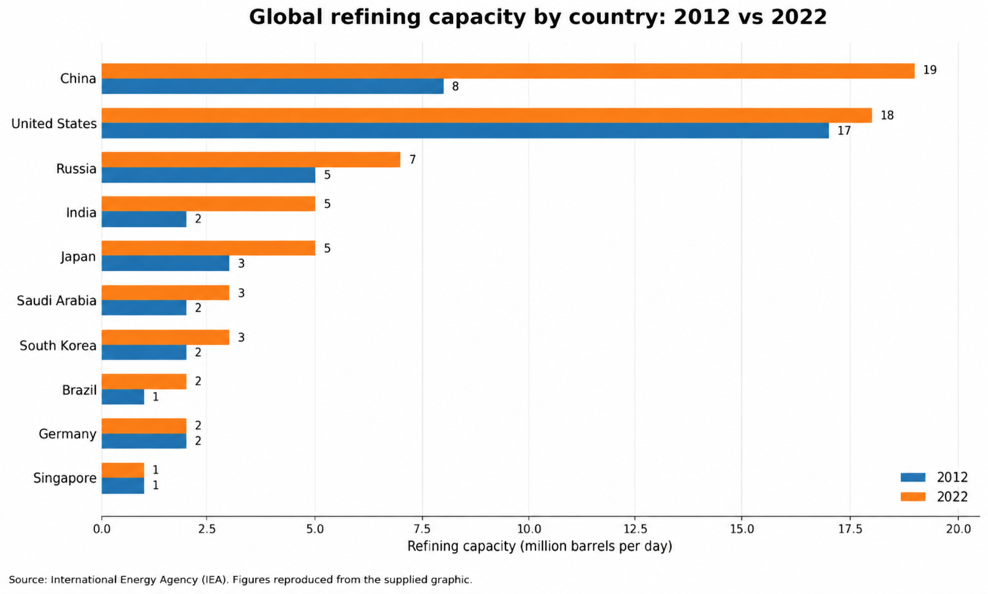
Figure 1. Refining capacity, 2012 and 2022. Source: Energy Institute, Statistical Review of World Energy 2023.
European environmental regulations and the scarce popularity of these plants with European voters have both been instrumental in Europe distancing itself from the refinery market. The current episode highlights once more the political short-sightedness of European environmental regulation.
A first response from government: use the tax system
Many European countries’ immediate response has followed the familiar fiscal route. Various European governments implemented temporary reductions to excise duties, VAT o other rebates. Italy also introduced a 2027 vehicle-tax exemption for small and medium cars.
Such measures have an obvious attraction: they are fast, visible and administratively simple. They also have familiar drawbacks. A universal reduction benefits high-income and low-income motorists alike and carries a substantial fiscal cost. It can also blunt the demand response that a scarcity price would otherwise produce. If the underlying problem is that too little diesel is available globally, keeping retail demand higher does not create another barrel of diesel.
Yet the alternative – tightly targeted relief – is less straightforward than it sounds. A broad scheme inevitably helps people who could absorb the shock without assistance; a narrow scheme inevitably excludes some households or businesses whose circumstances do not fit the chosen eligibility test. Income, geography, commuting distance, disability, access to public transport and the fuel intensity of employment all matter. There is no perfectly targeted emergency instrument.
Italy’s other route: leverage on politics and industry
Italy is now experimenting with a different channel. From 28 September, state-controlled oil company Eni capped fuel prices on its own sale network at €1.99 per litre for petrol and €2.19 for diesel for an initial thirty days, with a possible extension depending on market and supply conditions. IP – the second player in Italian fuel pump market, owned by the Azeri government – subsequently followed Eni, with Q8 (owned by the Kuwaiti government) signaling its intention to join the price cap. All in all these three players own more than half of fuel pumps in Italy. This moves the policy debate away from the tax code and toward the structure of the fuel industry itself.
Eni structure is quite unique in the market: it is an integrated energy group operating across exploration and production, trading, refining, logistics and end-market sales. The Italian state, through the Ministry of Economy and Finance and Cassa Depositi e Prestiti, holds 33.09% of Eni’s share capital and exercises de facto control. Eni’s own retail network counted 3,982 Italian service stations at the end of 2025.
Also IP operates an integrated industrial and logistics system that includes two refineries, storage assets and a nationwide retail network. It therefore also has physical assets upstream of the petrol station, although its configuration and degree of integration differ from Eni’s global model.
Many international oil companies have reduced, separated or sold parts of their downstream retail and refining portfolios, while Eni retained its integrated structure. In a product shortage, this has become a strategic advantage: margins earned in one part of the chain can, at least temporarily, absorb pressure in another.
This policy has also raised legitimate competition-policy question: Eni potentially may be accused of unfair competition if it were to sell wholesale product at market-linked prices, therefore causing unfair disadvantage to independent.
The deeper lessons: refining capacity is strategic infrastructure, and politics is back again.
The most interesting feature of Italy’s response is what the episode says about industrial structure and the role of government in the economy. For years, discussions of energy security focused primarily on access to crude oil and natural gas. The 2026 fuel shock shows that energy security depends not only on access to crude oil, but also on the infrastructure required to transform and distribute it. Europe’s declining refining capacity has increased its exposure to disruptions in global trade. Italy’s response illustrates how an integrated industrial base and public leverage can provide additional policy options in a crisis. The broader lesson is that refining capacity should once again be regarded as strategic infrastructure, not simply as another market activity.

