



For decades, organizations have operated under a simple assumption: if something improves performance, then more of it should improve performance even further. Governments increase research funding to stimulate innovation. Universities compete aggressively for grants and expand their undergraduate and graduate programs. Businesses invest heavily in research and development, recruit more talent, and launch new projects. Start-ups raise more funds and chase rapid growth, believing that scaling quickly is the best route to success.
The underlying logic seems undeniable. More resources should lead to better outcomes. But what if that assumption is only true up to a point? My recently published study (co-authored with Vasilis Theoharakis of Cranfield University) in the British Journal of Management, which was subsequently featured by the Financial Times, set out to answer precisely this question. By analyzing data from 108 UK business schools submitted to the Research Excellence Framework (REF2021), we discovered something both surprising and highly relevant, not only for universities, but for organizations of every kind. The message is simple: ‘More is not always better.’
The hidden cost of growth
Universities around the world face intense pressure to improve their research performance. Success is often associated with securing larger research grants, expanding doctoral programs, and increasing research activity. At first glance, this strategy makes perfect sense. First, external funding allows universities to recruit talented researchers, invest in infrastructure, purchase equipment, and support ambitious research projects. Second, doctoral students contribute fresh ideas, assist with research, and help build vibrant academic communities. And our research confirms that these investments do indeed improve performance, at least initially.
However, as institutions continue to accumulate research funding and supervise ever larger numbers of doctoral students, the relationship begins to change. Instead of producing continuous positive returns, additional resources eventually yield diminishing returns. Beyond a certain point, performance can even begin to decline. This pattern is known in research as an ‘inverted U-shaped relationship.’
To help you understand this relationship, you can imagine watering a plant. Too little water prevents growth. The right amount allows it to flourish. Too much water eventually damages the roots. Organizations often behave in exactly the same way.
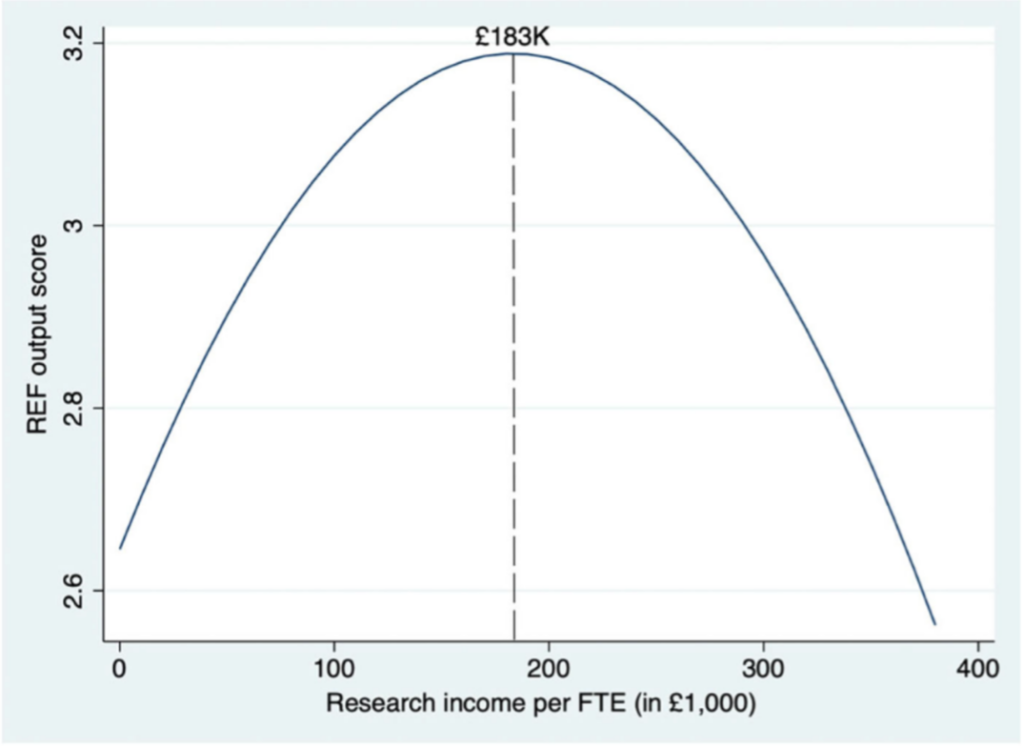
Figure 1. Every organization has a funding sweet spot. Research quality improves as research funding increases, but only up to an optimal level. Beyond approximately £183,000 of research income per full-time academic, additional funding generates diminishing and eventually negative returns.
When success creates new problems
Why would having more resources become a disadvantage? The answer lies in organizational capacity. As research funding increases, so too does administrative complexity. Academics spend more time managing grants, writing reports, coordinating teams, meeting funder requirements, and complying with regulations. Similarly, expanding doctoral programs creates heavier supervision demands. Faculty members devote increasing amounts of time to mentoring students, coordinating projects, and maintaining program quality. These activities are valuable, but they also consume one of the most limited organizational resources of all, which is ‘managerial attention.’
Every organization has a finite capacity to coordinate people, projects, and knowledge. Beyond that capacity, complexity begins to outweigh the benefits of additional investment. The organization becomes increasingly occupied with managing growth rather than creating value. In other words, growth starts generating its own costs.
A lesson far beyond universities
Although our research focused on higher education, the underlying principle applies much more broadly. Businesses frequently assume that expanding teams, increasing budgets, or launching additional projects will automatically improve performance. Yet many executives have experienced the opposite. Large organizations often discover that communication becomes slower, decision-making becomes more bureaucratic, and coordination consumes increasing amounts of time. Instead of enabling innovation, additional layers of management can reduce organizational agility.
The same phenomenon appears in many industries. Technology companies eventually struggle with organizational complexity. Professional service firms reach limits in effectively managing larger client portfolios. Healthcare systems face growing coordination challenges as services expand. Even governments encounter diminishing returns when additional programs create administrative burdens that outweigh their intended benefits.
Growth itself is rarely the problem. Managing growth effectively is.
Not all organizations are created equal
Our study also revealed another interesting finding. The UK’s Russell Group universities, that is, the country’s most research-intensive institutions, were able to sustain higher levels of research investment before experiencing diminishing returns. This does not necessarily mean they employ better researchers. Rather, these universities possess organizational capabilities that allow them to absorb greater complexity. They have stronger research infrastructure, more experienced administrative support, well-established research cultures, and systems refined over decades. These capabilities increase organizational capacity. As a result, they can manage larger research portfolios without sacrificing research quality as quickly as other institutions. This offers an important lesson for leaders. Competitive advantage is not determined solely by the quantity of resources an organization possesses. It also depends on how effectively those resources are organized, coordinated, and deployed. Capabilities matter as much as resources themselves.
Our findings are illustrated in Figure 2 below. The curves show that research performance initially improves as research income per academic increases. However, beyond a certain threshold, the benefits of additional funding begin to diminish. More importantly, the figure demonstrates that Russell Group business schools are able to sustain higher levels of research income before experiencing these diminishing returns, suggesting that stronger institutional capabilities allow them to absorb greater research investment without sacrificing research quality.
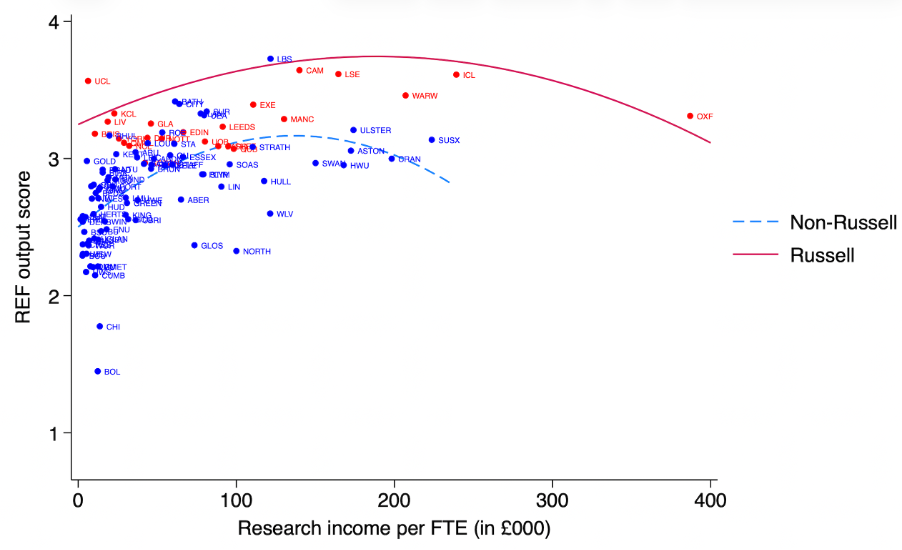
Figure 2. Research funding and research quality across Russell and non-Russell group business schools. Why more is not always better.
An encouraging finding
One of the most encouraging findings from our study concerned research impact. While Russell Group universities produced higher research output quality overall, they did not enjoy the same advantage when it came to generating societal impact. In other words, institutions outside the traditional research elite proved equally capable of creating meaningful value for society.
How? They simply followed different pathways. Large research-intensive universities often influence international policy, global debates, and major scientific challenges. Many smaller universities, meanwhile, work closely with local communities, regional businesses, public organizations, and charities, producing immediate and tangible societal benefits. Different routes can lead to equally meaningful impact. This reminds us that success should not always be measured by size or prestige alone. Sometimes, proximity, agility, and local engagement can be just as valuable as global scale.
The leadership challenge
Perhaps the most important implication of our findings is that leaders should rethink what success looks like. Organizations often celebrate continuous growth. More employees. More projects. More funding. More expansion.
Yet every organization possesses a finite capacity to coordinate increasingly complex activities. Crossing that threshold does not necessarily produce better outcomes. Instead, leaders should focus on optimization rather than maximization. The objective should not be to accumulate as many resources as possible, but to identify the level at which those resources generate the greatest value. This requires investing not only in growth, but also in the capabilities that enable organizations to manage that growth effectively.
In today’s increasingly complex environment, sustainable success depends less on asking, “How can we get more?” and more on asking, “How much is enough?”
That may be one of the most difficult questions any organization can answer. It may also be one of the most important.
Because in management, as in many aspects of life, the organizations that perform best are often not those with the most resources, but those that understand the limits of their own capacity and know how to strike the right balance.
Reference
- Theoharakis, V. and Batsakis, G. (2026), Too Much of a Good Thing? Striking a Balance Between Research Environment Inputs and Research Output Quality in UK Business Schools. Br. J. Manag. e70074. https://doi.org/10.1111/1467-8551.70074
George Batsakis

