


A Plastic Planet and a Plastic Body
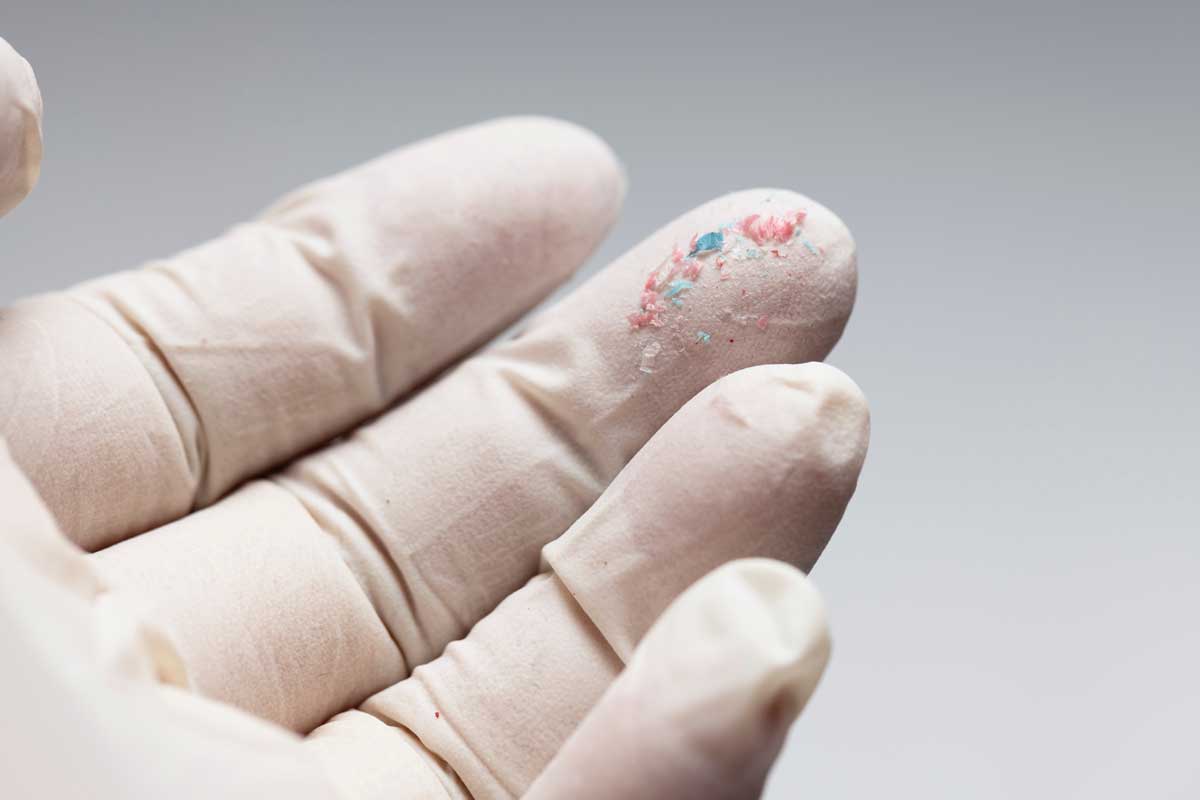
We live in the age of plastic. Since the mass production of synthetic polymers began in the mid-twentieth century, global output has grown relentlessly — from 234 million tonnes in 2000 to roughly 460 million tonnes in 2019. Yet for every tonne manufactured, only about one-fifth is ever recycled or incinerated. The rest accumulates in landfills, waterways, and open environments, where sunlight, heat, and mechanical abrasion gradually shatter it into ever-smaller fragments. When those fragments fall below five millimetres in size, scientists call them microplastics. When they shrink below one micrometre, they become nanoplastics.
For decades, the concern about plastic centred on the visible: the straws lodged in sea turtle nostrils, the bags filling ocean gyres, the bottles rolling down riverbanks. Today, however, a quieter alarm is sounding. Microplastics have been detected in Arctic snow, in the deepest ocean trenches, in the food we eat and the air we breathe — and, increasingly, inside the human body itself. They have been found in human blood, breastmilk, lung tissue, the placenta of unborn children, and, most alarmingly, embedded in arterial plaque. The question scientists are urgently trying to answer is no longer whether microplastics are inside us, but what they are doing there.
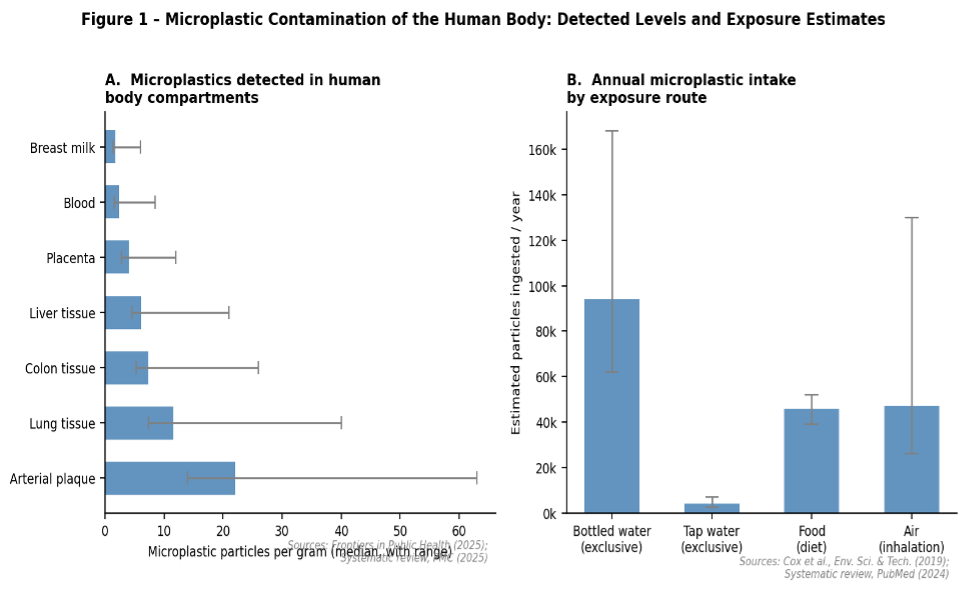
Figure 1 – Main routes by which microplastics enter the human body (food, water, air, and skin) and the organs where accumulation has been documented. Sources: Frontiers in Public Health (2025); NEJM (2024); Stanford Medicine (2025).
How We Are Exposed
The routes of exposure are surprisingly diverse (Figure 1). The most obvious is ingestion through food and water. Seafood — particularly shellfish, which filter large volumes of seawater — is a concentrated source. Salt, honey, beer, and bottled water have all been found to contain microplastic particles. A wide-ranging study published in Environmental Science & Technology estimated that Americans consume between 39,000 and 52,000 microplastic particles each year through diet alone; when inhalation is factored in, that figure jumps to between 74,000 and 121,000. People who rely exclusively on bottled water for hydration may ingest an additional 90,000 particles annually compared with those who drink only tap water.
Inhalation is the second major pathway. Airborne microplastics are shed by synthetic textiles, tyre and brake wear, and the fragmentation of plastic waste in outdoor and indoor environments. Research shows that indoor air can contain between 0.1 and 1.2 microplastic particles per cubic metre, with urban spaces typically showing higher concentrations. Fine particles below ten micrometres can reach deep into the lungs; particles smaller than one micrometre may cross into the bloodstream. Dermal absorption, while less studied, has also been identified as a potential pathway, particularly for nanoplastics.
A popular statistic that made headlines claimed humans swallow the equivalent of a credit card of plastic every week. While that figure has since been challenged on methodological grounds — more rigorous calculations suggest considerably lower mass — what is not in dispute is that exposure is universal, continuous, and increasing. Microplastics have been detected in 83 % of global tap-water samples, and in studies of human placental tissue, cord blood, and meconium (a newborn’s first stool), confirming that exposure begins before birth.
What the Science Says About Health Risks
The health evidence is still evolving, but the trajectory is concerning. One of the most striking studies to date, published in The New England Journal of Medicine in March 2024, examined patients who had undergone surgery to remove arterial plaque. Researchers detected microplastics and nanoplastics within the plaque itself, and found that patients who had plastics in their plaque faced a significantly higher risk of heart attack, stroke, and death over the following two years compared with those who did not. Subsequent laboratory work at Stanford Medicine found that microplastics can penetrate vascular cells and trigger major changes in gene expression — a possible mechanism for the cardiovascular harm observed clinically.
Beyond the heart, evidence is accumulating across multiple organ systems. In the gastrointestinal tract, microplastics appear to disrupt the gut microbiome, promoting dysbiosis — an imbalance in microbial communities — as well as inflammatory responses. Associations have been reported with inflammatory bowel disease. In the lungs, inhaled particles provoke inflammation and may contribute to fibrotic changes. Animal and human studies suggest that microplastics act as endocrine disruptors, interfering with hormonal signalling in ways that may affect reproductive health: reduced sperm quality, altered ovarian function, and links to infertility have all been documented, albeit with varying levels of evidence. There are emerging concerns about neurotoxicity too — microplastics have been shown to cross the blood-brain barrier in animal models, and epidemiological studies are beginning to probe associations with neurodegenerative diseases such as Parkinson’s and Alzheimer’s. Finally, chemical additives carried on plastic particles — plasticisers, flame retardants, heavy metals, and persistent organic pollutants — add a further layer of toxicological complexity, since these compounds can leach out once inside the body.
It is important to stress that much of the evidence at this point is associational rather than definitively causal, and that animal studies do not always translate directly to human outcomes. Nevertheless, the breadth of the observed effects, across so many body systems and so many independent research groups, is striking enough to warrant serious precautionary action.
The Policy Challenge: Regulating the Invisible
Addressing microplastic contamination requires tackling the problem at its source — and that means confronting one of the world’s most powerful industries. In 2022, 175 nations agreed at the UN Environment Assembly to develop a legally binding Global Plastics Treaty, with negotiations scheduled to conclude by the end of 2024. As Figure 2 illustrates, that deadline has already been missed twice. The fifth session of talks (INC-5) collapsed in Busan in November 2024 without agreement, and a resumed session in Geneva in August 2025 (INC-5.2) also ended without a final text.
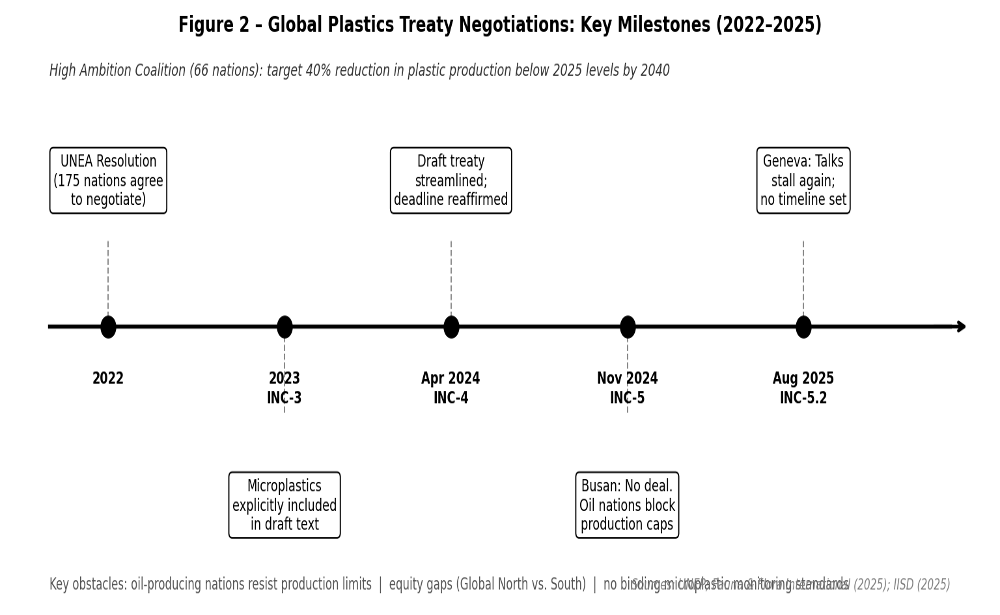
Figure 2 – Timeline of key milestones in the global negotiations for a Plastics Treaty (2022–2025), highlighting the recurring stalling of talks and the key political obstacles to agreement. Sources: UNEP; Fauna & Flora International (2025); IISD (2025); WWF (2025).
The fracture lines in the negotiations are revealing. A coalition of 66 nations — the High Ambition Coalition — is pushing for measures that address the full lifecycle of plastics, including binding caps on virgin plastic production and targets to reduce global output by 40 % below 2025 levels by 2040. Against them stand oil-producing nations and major plastic manufacturers, who argue that production limits are economically unacceptable and prefer to focus on improving recycling rates and waste management. This is, at its core, a familiar tension in environmental politics: the effort to shift the burden of action upstream, to where plastic is made, rather than leaving it downstream, with the consumer or the waste collector.
Microplastics specifically have been a point of contention throughout the negotiations. Including monitoring obligations for microplastics — in drinking water, food, and the wider environment — requires both scientific infrastructure and funding that many lower-income countries do not yet have. Equity concerns are genuine: the same developing nations that generate the least plastic per capita are often most exposed to its consequences, through inadequate waste management and dependence on coastal fisheries. Any credible global agreement will need to address this imbalance with dedicated financial and technical support.
Outside the treaty process, individual jurisdictions have begun to act. The European Union has extended regulations to cover plastic pellet losses across the supply chain, is scrutinising the use of sewage sludge — a concentrated source of microplastics — as agricultural fertiliser, and is introducing monitoring requirements for microplastics in drinking water. California has mandated testing for microplastics in drinking water sources. These are meaningful steps, but they remain piecemeal in the absence of a global framework.
What Needs to Happen
The microplastics crisis sits at the intersection of environmental science, public health, industrial policy, and international diplomacy. The science, while still maturing, is sufficiently alarming to justify the precautionary principle: we should not wait for proof of irreversible harm before acting. Three priorities stand out.
First, the global plastics treaty negotiations must succeed — and must include upstream production constraints, not just downstream waste management. A treaty that only improves recycling while plastic production continues to rise is like mopping the floor while leaving the tap running.
Second, binding standards for monitoring microplastics in drinking water, food, air, and human tissue need to be established internationally. Without consistent measurement, we cannot track the problem, evaluate policies, or hold polluters accountable. This includes funding for the scientific capacity that lower-income countries need to participate meaningfully.
Third, at the individual level, reducing exposure where possible is prudent: favouring tap water over bottled water, limiting single-use plastics, and ventilating indoor spaces reduce intake. These are not solutions — they are precautions — but they matter while the policy machinery catches up with the science.
The plastic age has brought extraordinary convenience. It has also filled our bodies with materials that were never meant to be there. Understanding what that means, and doing something about it, is one of the defining public health challenges of the coming decades.
Key sources:
Frontiers in Public Health (2025); Frontiers in Environmental Science (2025); The New England Journal of Medicine (2024); Stanford Medicine (2025); Environmental Science & Technology (2019); UNEP; Fauna & Flora International (2025); IISD Global Plastics Treaty Guide (2025); WWF Plastic Pollution Treaty page (2025); Frontiers in Marine Science (2025).

