


The VortexWeekly Economic and Financial News (Sept 28 – Oct 4, 2025)
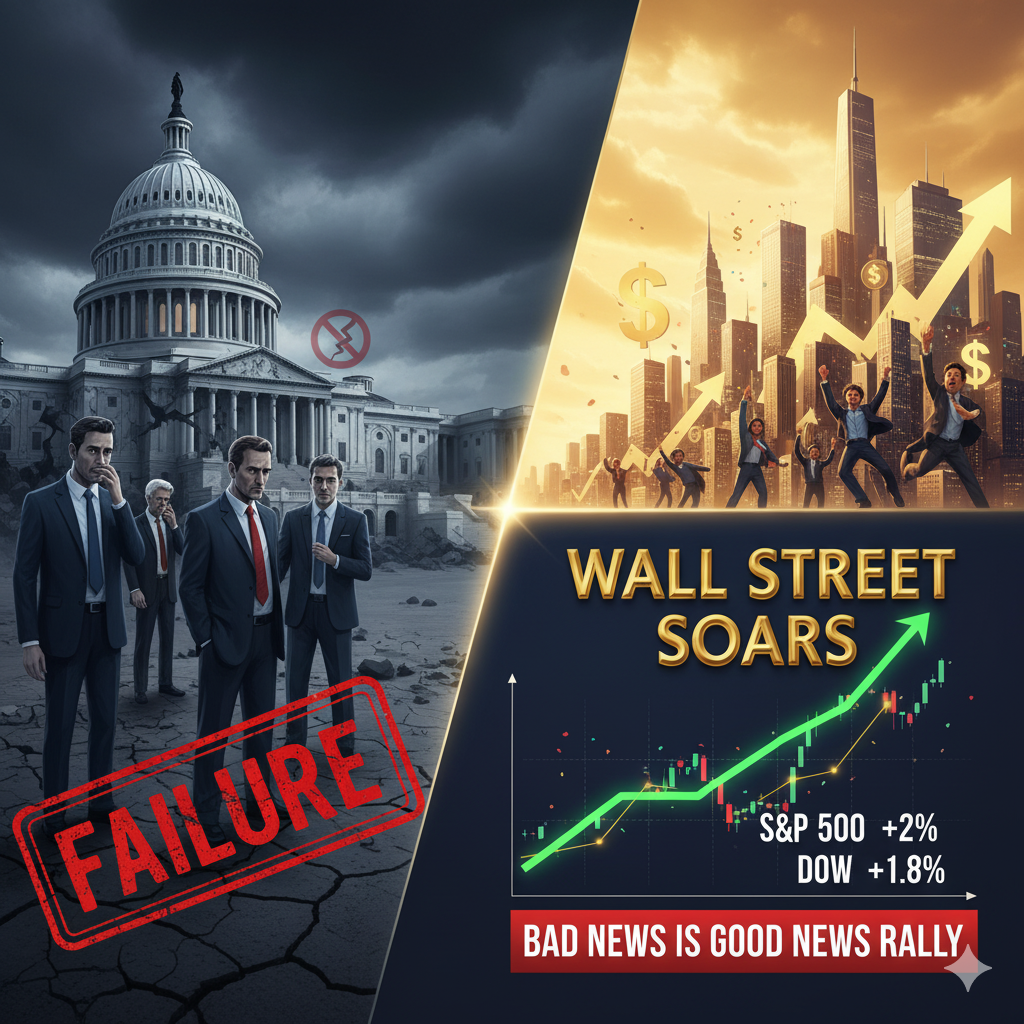
Summary: The financial world (Sept 28 – Oct 4, 2025) split into two stories: US political paralysis and the unstoppable global tech rally. The US government entered a shutdown, delaying key data like the crucial September jobs report. This uncertainty pushed bond yields down initially. Meanwhile, Artificial Intelligence (AI) optimism drove Asian and European tech stocks to new highs, highlighted by a major chip deal in South Korea. China’s manufacturing sector showed subtle improvement, but overall global economic growth remained uneven due to trade tensions. Central bank policy diverged, with the Fed expected to continue rate cuts while the ECB and BOJ hold firm.
Introduction: A Week of Uncertainty and Divergence ⚖️
The week of September 28th to October 4th, 2025, ended with a global economy navigating a complex and often contradictory landscape. In the United States, a government shutdown cast a long shadow, notably delaying the highly anticipated Non-Farm Payrolls report. This blackout of official data complicated the narrative around the Federal Reserve’s recent interest rate cut. Amidst this uncertainty, the technology sector continued its impressive ascent, propelled by relentless demand for Artificial Intelligence. However, persistent tariff-driven inflation and a darkening outlook for crude oil prices kept investors on edge. Let’s dissect the key economic narratives that shaped this pivotal week
The US Government Shutdown & Labor Market Freeze 🧊
The most dominant headline impacting US markets this week was the ongoing government shutdown. Commencing before September 28th, the shutdown forced the Department of Labor to postpone the release of several critical economic indicators. Most notably, the highly anticipated September Non-Farm Payrolls report, originally scheduled for October 3rd, was delayed indefinitely. This data vacuum left markets and the Federal Reserve guessing about the true health of the labor market.
Alternative Labor Market Indicators (September Data):
With official data on hold, analysts turned to private sector reports for insights into employment trends. The ADP Private Sector Employment report for September offered a stark warning:
- Decline of 32,000 jobs, marking the largest monthly decrease in over two years. This figure strongly reinforced concerns about a significant slowdown in job creation.
Further underscoring this trend, a report from Challenger, Gray & Christmas indicated that nearly 950,000 layoffs had occurred through September 2025—the highest annual total since 2020. Hiring plans were also at their lowest level since 2009. While announced job cuts for September specifically were down 37% from August, the overall trend points to a cooling, if not contracting, labor market. The absence of the official jobs report created significant uncertainty for the Fed, which had just cut rates in part due to a “slowdown in job gains.”
Federal Reserve Navigates Uncertainty Amidst Tariff-Driven Inflation 📈
The Federal Reserve’s policy decisions now face a dual challenge: a slowing labor market (as per alternative data) and persistent inflation, complicated by a government data blackout. On September 17, 2025, the Fed made its first rate cut of the year, reducing the federal funds rate target to 4.00%–4.25%. This move was justified by “a moderation in economic activity growth, a slowdown in job gains, an uptick in the unemployment rate, and elevated uncertainty.” Crucially, the committee noted “downside risks to employment have risen.”
However, inflation continues to be a stubborn problem, fueled predominantly by the ongoing impact of tariffs. The price level from all 2025 tariffs is estimated to rise by 1.7% in the short run under a “baseline scenario,” according to The Budget Lab at Yale. Core goods inflation has reportedly increased for three consecutive months due to these effects. The overall effective tariff rate for consumers is now estimated at a staggering 17.4%, the highest since 1935.
J.P. Morgan research, updated this week, projects US core inflation (PCE) to end 2025 at an “uncomfortably firm” 3.4%. This significantly exceeds the Fed’s 2% target, complicating any further easing. Markets, however, are still pricing in a high probability of two more 25 basis point cuts by year-end, driven by the perceived weakening in employment. The next FOMC meeting (October 28-29) will be critical, especially if official jobs data remains unavailable.
Tech Sector Defies Gravity: AI Continues Its Soaring Ascent 🚀
Amidst the economic fog, the technology sector remained a beacon of relentless growth. The week saw continued investor frenzy around Artificial Intelligence, driving tech stocks to new highs. The Nasdaq (NDX), in particular, registered a fresh all-time high during the week, closing up more than 1.2%. This pushed the index into a critical resistance zone, yet the bullish momentum showed little sign of abating.
AI’s Dominant Influence:
- Oracle’s Cloud Ambitions: While the reported $20 billion Meta AI cloud deal (from late September) continued to fuel speculation and boost investor confidence in Oracle, the confirmed £50 million five-year licensing deal with the UK Home Office (announced October 6) underscored Oracle’s growing momentum in securing large-scale, critical infrastructure contracts.
- Chipmakers Thrive: Key AI chipmakers such as Nvidia (NVDA), Broadcom (AVGO), and Advanced Micro Devices (AMD) all posted gains, benefiting from massive investments into AI-capable data centers. Hyperscalers (e.g., Amazon, Microsoft, Google) project capital expenditures exceeding $250 billion in 2025 on new AI infrastructure.
This strong performance highlights a significant divergence in the market: traditional sectors face headwinds from tariffs and slower consumer spending, while the innovation-driven tech sector continues to draw enormous capital. Technical analysts, however, noted “daily divergence” warnings for both the S&P 500 and Nasdaq, suggesting that the rapid rally might face near-term consolidation.
Crude Oil Prices Face Oversupply Fears & Global Growth Reassessment 🌍🛢️
The commodity markets experienced a notable shift this week, particularly in crude oil. Brent Crude prices, which began the week around $70.13 per barrel, saw a sharp decline. On Monday, September 29, Brent crude slid 3.1% to settle at $67.97 a barrel. This drop was largely driven by signals that the OPEC+ alliance is considering hiking production again in November. This potential increase in supply dampened the bullish sentiment that had briefly pushed prices higher due to earlier geopolitical tensions.
Bearish Outlook for Q4 2025:
- Macquarie recently revised its oil price forecasts, now predicting Brent Crude will average just $63 per barrel in Q4 2025.
- The US Energy Information Administration (EIA) also forecast a drop to $59/b in the fourth quarter.
- J.P. Morgan warned that market dynamics point to lower prices in the coming months due to an “heavily oversupplied oil market,” raising the risk of another “market reset” in 2026. This potential energy cost relief could offer a silver lining for inflation-hit economies, but poses challenges for oil-exporting nations.
Global Growth Outlook: The IMF’s July 2025 update had projected global growth at a modest 3.0% for 2025. However, the full World Economic Outlook for October 2025, scheduled for release on October 14, is expected to focus heavily on the accumulating downside risks. These include the impact of high tariffs, persistent geopolitical tensions, and broader economic uncertainty. The policy divide between central banks (e.g., the Fed grappling with tariffs vs. the ECB facing less direct inflationary pressure) underscores the fragmented global economic recovery.
Navigating a Shifting Economic Landscape
The week of September 28th to October 4th, 2025, presented a complex tapestry of economic events. The US government shutdown introduced a layer of fog, while the Fed juggled a recent rate cut with stubborn, tariff-driven inflation. Yet, the tech sector continued its robust rally, underscoring the power of innovation. As we look ahead, the interplay between policy decisions, geopolitical events, and technological advancement will continue to define the global economic trajectory. Businesses and investors must remain agile, focusing on strategic foresight to navigate these turbulent waters.

