



Global Markets Roiled by Inflation Fears & Geopolitical Tensions 🌍
The Vortex Weekly Economic and Financial News (Sept 21-27, 2025)
Summary: This past week, global financial markets navigated a turbulent landscape, grappling with persistent inflation concerns, evolving central bank stances, and a fresh wave of geopolitical uncertainties. The US saw mixed economic signals, while the EU braced for a potential energy crunch. Asia, meanwhile, experienced both growth momentum and significant regulatory shifts. Investors are increasingly seeking safe havens amidst volatility.
North America: Fed’s Tightrope Walk & Shifting Sands in the Job Market 🇺🇸
The week in the US was dominated by Federal Reserve rhetoric and evolving economic data. While inflation showed some signs of cooling in certain sectors, overall price pressures remained a significant concern. The Consumer Price Index (CPI) for August (released earlier in September) indicated a higher-than-expected core inflation rate of 4.2% year-over-year, leading to increased speculation about the Fed’s next moves. Analysts are now largely pricing in another 25-basis-point rate hike in November, even as the jobs market shows subtle signs of easing.
Chart 1: US Core CPI (August 2024 – August 2025) 📊

Year-over-year percentage change in US Core Consumer Price Index.
Federal Reserve Chairman Jerome Powell, in a speech on Thursday, reiterated the central bank’s commitment to price stability, stating that “the job is not yet done.” This hawkish stance sent ripples through equity markets, with the S&P 500 closing down 1.5% on Friday. Meanwhile, initial jobless claims unexpectedly rose to 220,000 for the week ending September 21st, suggesting a potential loosening in the tight labor market. This mixed bag of data presents a challenge for policymakers attempting to engineer a “soft landing.” The dollar strengthened against a basket of major currencies, reflecting safe-haven demand.
European Union: Energy Woes & Economic Resilience Under Scrutiny 🇪🇺
Europe faced a challenging week, with renewed concerns over energy security and the ongoing conflict in Eastern Europe casting a long shadow. Gas prices saw a notable uptick as winter approaches, fueled by uncertainties surrounding supply from key regions. The European Central Bank (ECB) signaled continued vigilance on inflation, with President Christine Lagarde emphasizing that “further rate adjustments cannot be ruled out.” The Euro Stoxx 50 index declined by 1.2% over the week.
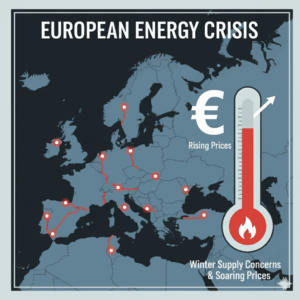
A graphic illustrating the challenges of energy supply in Europe.
While initial Q3 GDP forecasts remained cautiously optimistic, the manufacturing sector showed signs of contraction in several key economies, as reflected in the latest Purchasing Managers’ Index (PMI) data. Germany’s manufacturing PMI dipped to 48.5, indicating a shrinking sector. Consumer confidence also remained subdued across the bloc, reflecting the squeeze from high energy costs and persistent inflation. The ongoing debate over fiscal consolidation versus supporting economic growth intensified among member states, creating a complex policy environment for the region.
Asia: Growth Pockets Amidst Regulatory Shifts & Trade Dynamics 🌏
Asian markets presented a more varied picture. China’s economic recovery continued, with industrial production showing robust growth of 5.8% year-on-year in August. However, concerns about the real estate sector and potential regulatory crackdowns lingered. The People’s Bank of China (PBOC) maintained a relatively stable monetary policy, aiming to support growth without fueling excessive inflation. The Shanghai Composite Index saw modest gains of 0.8% over the week.
Chart 2: China Industrial Production (August 2024 – August 2025) 📈

Year-over-year percentage change in China’s Industrial Production.

