



Summary: This article presents a thorough overview of the evolution, scale, and current significance of social media, situating it within broader social, cultural, and technological contexts. It traces the origins of social media back to early networked communication systems, such as ARPANET, bulletin board systems, and Usenet, illustrating that social media is not merely a sudden emergence of Web 2.0, but rather the result of decades of gradual innovation. Key milestones are highlighted, including the emergence of profile-based networks in the 1990s and the rise of major platforms in the early 2000s, such as Facebook, YouTube, and Twitter. The article also notes the mobile- and video-centric transformation of the 2010s, driven by platforms like Instagram, Snapchat, and TikTok.
Furthermore, it documents the rapid global adoption of social media, which grew from fewer than one billion users in 2010 to over 5.2 billion by 2025—representing more than 60% of the world’s population—while also acknowledging that growth is now decelerating as markets mature and approach saturation. It analyzes platform-specific trends, user engagement patterns, and the increasing prevalence of short-form video content. Importantly, the article emphasizes that social media platforms function as service-based products, making continuous innovation crucial due to the ease of imitation. Lastly, it underlines that future competitiveness will hinge on platforms’ abilities to tackle privacy concerns, manage identity, address attention constraints, and adapt to shifting cultural expectations in a rapidly evolving digital landscape.
Introduction
We find ourselves in a world that is deeply intertwined with social media. From politics and sports to business and culture, a life without social media is nearly unimaginable. However, the roles, nature, and purposes of social media are not static. In a fast-paced environment characterized by disruptive innovation, social media is in a constant state of evolution. Yet, there are indications that suggest the popularity and usage of social media may be approaching a plateau. For instance, Meta, the social media giant, has introduced incentives for influencers to migrate to Facebook—often regarded as the elder statesman of social media, yet increasingly seen as less appealing to younger audiences. Like any other technological and lifestyle product, social media must continuously innovate. The evolving consumer needs, shifts in lifestyle, and the ever-changing technological landscape (including developments in AI and the metaverse) necessitate that social media remains innovative to stay ahead. This article explores the mutual and reciprocal interrelationships between social media and the broader ecosystem of social, cultural, and technological environments.
Social media evolution
The history of social media can be traced back to the late 1960s, indicating that it did not emerge suddenly and is not solely a product of Web 2.0 or smartphone-driven innovations. Notably, ARPANET, established in 1969, along with bulletin board systems (BBS) and Usenet from the late 1970s and 1980s, allowed users to post messages, engage in discussions, and create early online communities. ARPANET laid the technical and communicative groundwork for networked communication through email and message exchanges, while BBS facilitated message posting, file sharing, and asynchronous interaction among users with shared interests, thus introducing a model of community-based participation. These platforms introduced the foundational idea of networked social interaction beyond one-to-one communication.
In the subsequent years, particularly during the 1990s, there was a significant transformation marked by the emergence of profile-based networks. SixDegrees.com, often regarded as the first recognizable social networking site, allowed users to create profiles, establish friend lists, and message one another—features that are now fundamental to modern social media. Although the site ultimately struggled to achieve scalability, it laid the groundwork and established the prototype for future innovations in social media.
In the early 2000s, the adoption and use of social media gained significant momentum, a trend closely tied to the advent of Web 2.0, which made internet platforms more interactive. MySpace, launched in 2003, popularized personalized profiles and music-focused communities, while LinkedIn, also debuting in 2003, showcased how social networking could cater to professional identities. Facebook was launched on February 4, 2004, initially known as TheFacebook, by Mark Zuckerberg and his Harvard classmates. Originally limited to Harvard students, it served as an online social directory, quickly expanding to other U.S. universities and laying the groundwork for a global social networking giant. Following this, YouTube emerged in 2005, transforming content creation by facilitating mass video sharing, and Twitter, launched in 2006, introduced real-time, short-form communication, significantly influencing journalism, politics, and activism.
The 2010s saw a surge in social media usage, driven by the widespread adoption of smartphones and the emergence of numerous new platforms. Instagram (2010) and Snapchat (2011) focused on images, stories, and ephemeral content, reflecting a communication style centered around mobile devices. These platforms quickly gained popularity among younger audiences, who often prioritize discreet privacy while using images and video clips to express their dynamic lifestyles. Meanwhile, Facebook consistently innovated and introduced new features to maintain its competitive edge. The launch of TikTok (2016) marked a significant breakthrough, leveraging algorithmic recommendation systems to promote short-form video, influencer culture, and participatory creativity on an unprecedented scale.
Today’s social media ecosystem—defined by mobile access, platform algorithms, influencer economies, and real-time global interaction—is the outcome of these layered historical innovations, each reshaping how people communicate, organise, and express identity online
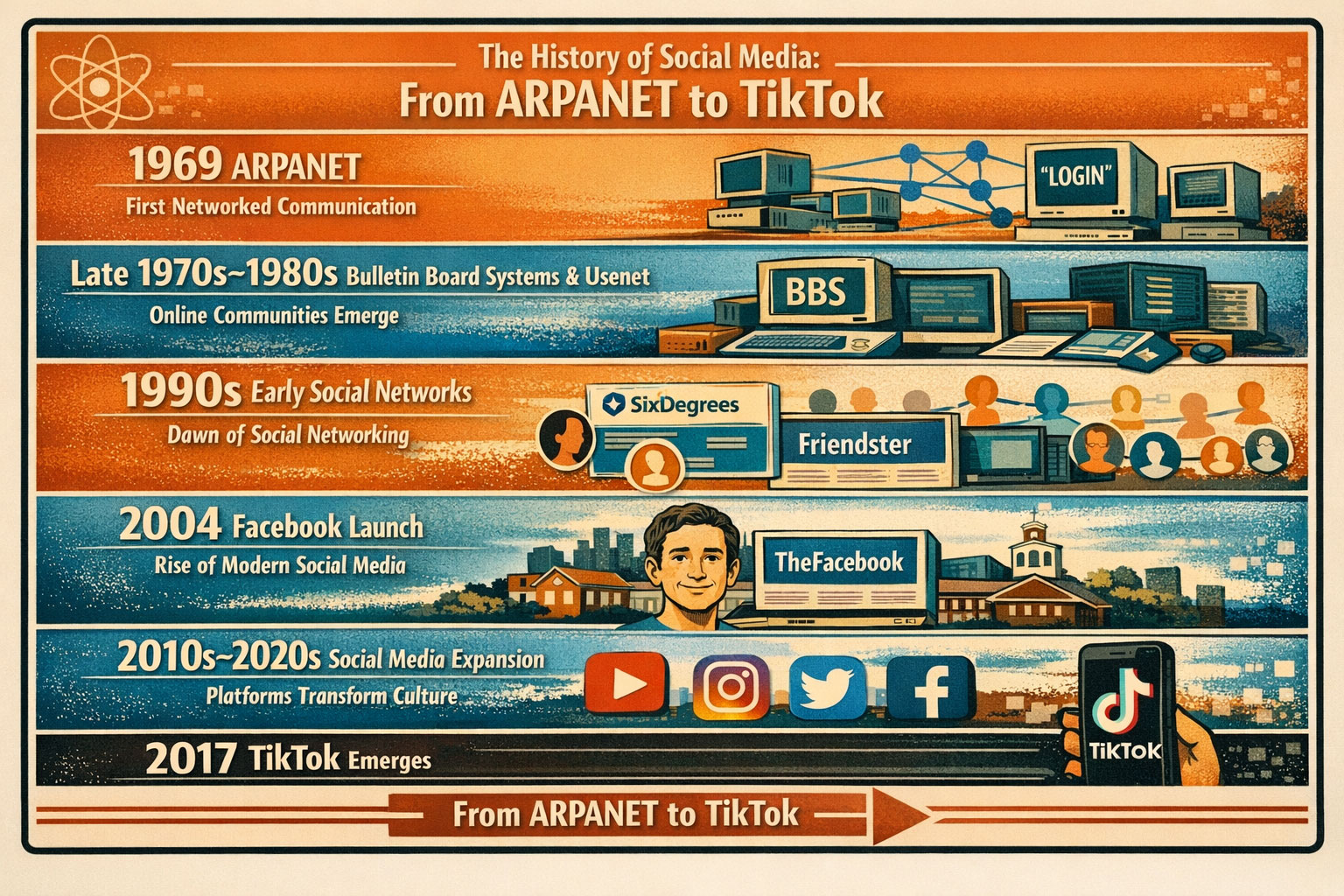 Figure 1: Evolution of social media; source: author’s design using Copilot
Current statistics of social media adoption
Based on the above discussion, it appears that over the past twenty years, social media has evolved from a niche digital phenomenon into a near-universal infrastructure for social interaction, information exchange, and economic activity.
At the start of this century, the adoption of social media remained relatively limited, with approximately 970 million users worldwide, largely concentrated in North America, Europe, and parts of East Asia. At that stage, social media platforms were still consolidating their business models, and smartphone penetration was uneven across regions. Nonetheless, the foundations for large-scale growth were already in place, driven by expanding broadband access and the increasing social centrality of platforms such as Facebook and Twitter.
Between 2010 and 2015, social media entered a period of accelerated expansion. User numbers more than doubled to 2.07 billion, reflecting the rapid diffusion of smartphones, falling data costs, and the rise of visually oriented and mobile-native platforms such as Instagram and WhatsApp. During this phase, annual growth rates were consistently high, signalling strong network effects as social media became embedded in everyday communication practices worldwide.
Growth continued at a pace through the mid-to-late 2010s, with global users reaching around 3.2 billion by 2018. At this point, annual growth rates peaked at close to 19–21%, supported by expansion into emerging markets, platform diversification, and increasing integration of social media into news consumption, entertainment, and commerce. This period also marked a shift from primarily text-based interaction to video-led and algorithmically curated content ecosystems.
By February 2025, social media usage had reached approximately 5.24 billion people, equating to over 60% of the world’s population. However, year-on-year growth had slowed to around 4.1%, reflecting a maturing market. In most regions, social media adoption is now approaching saturation among internet-enabled populations, and further expansion is increasingly constrained by the remaining global digital divide rather than platform demand itself.
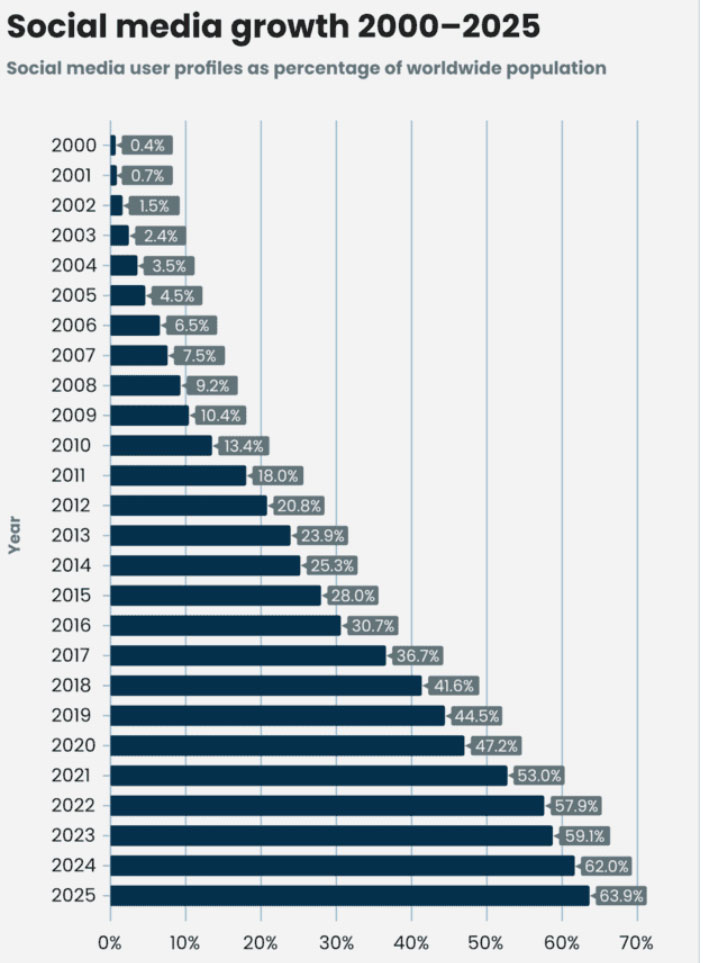 Figure 2 Growth of global social media use; source: https://www.dreamgrow.com/21-social-media-marketing-statistics/#:~:text=Social%20media%20growth%20over%20time,as%20internet%20and%20smartphone%20use.
Evolution of different social media platforms
Despite a recent decline in Facebook’s appeal among the younger generation, it continues to be the most popular social media platform, boasting 3 billion monthly active users worldwide. The platform has experienced a slower growth rate in recent years, averaging 3.4% annually. Facebook reached significant milestones, achieving 100 million users in 2008 and 1 billion by 2012. YouTube, on the other hand, has nearly 2.8 billion active users and stands out due to its unique product offerings and user engagement styles. Instagram and WhatsApp continue to hold the third and fourth spots globally, both of which are currently owned by Meta, which leverages its ownership of three of the four most popular social media platforms through platform integration. TikTok has introduced several innovative product features over the past decade and gained significant popularity, particularly during the pandemic, when many sought creative outlets to alleviate boredom during lockdowns. However, TikTok is banned in India, a vast country with a population of 1.4 billion, limiting its growth opportunities. It is also important to note that most of these platforms have seen legal restrictions and/or limited adoption in another large country – China.
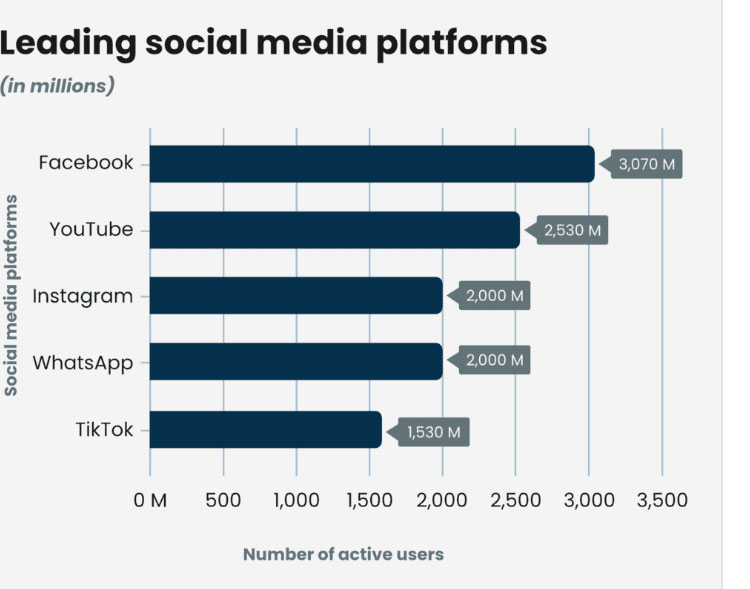
Figure 3: Global market share of different social media platforms; source: https://www.dreamgrow.com/21-social-media-marketing-statistics/#:~:text=Social%20media%20growth%20over%20time,as%20internet%20and%20smartphone%20use.
Founded in 2005 and acquired by Google in 2006, YouTube has benefited significantly from Google’s array of popular products like Gmail and Chrome, which have contributed to its growth. Recently, growth has been propelled by new features such as YouTube Shorts, which was launched in 2020. Shorts currently boasts over 2 billion monthly users and generates between 70 to 90 billion views each day.
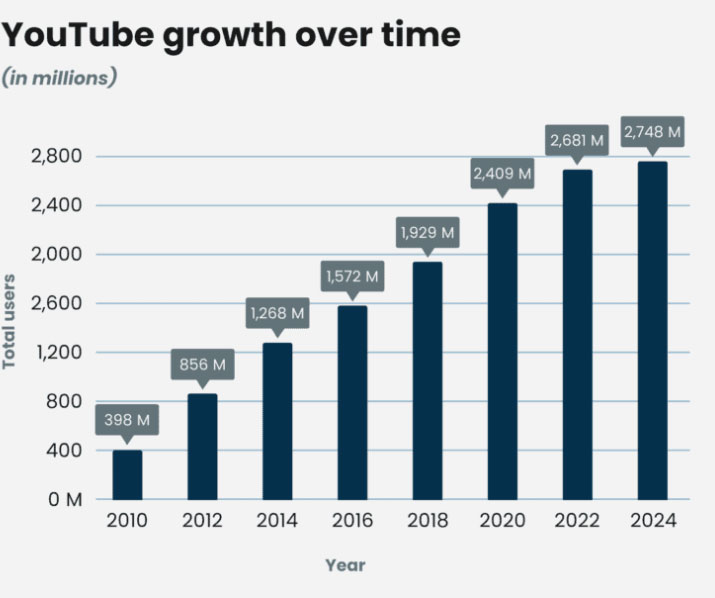 Figure 4:YouTube growth; source: https://www.dreamgrow.com/21-social-media-marketing-statistics/#:~:text=Social%20media%20growth%20over%20time,as%20internet%20and%20smartphone%20use.
User engagement behavior
Social media platforms continue to exert a significant influence on online behavior, with usage intensity and engagement providing valuable insights for brands and marketers. Globally, users now spend over 14 billion hours on social media each day, averaging 141 minutes (2 hours and 21 minutes) per person, which is only slightly lower than in 2024. This sustained level of engagement highlights social media’s central role in daily life.
The typical user now interacts with approximately 6.8 social platforms each month, reflecting a progressively fragmented yet interconnected digital landscape. Consequently, organizations benefit from maintaining a coordinated presence across multiple channels. Engagement with brands is also deepening, with 48% of consumers reporting more frequent interactions with brands on social media compared to six months ago.
Social media is not only a transactional space but is also culturally embedded. Around 90% of users turn to these platforms to follow trends and key moments, providing brands with opportunities to engage in broader conversations. Notably, short-form video has emerged as a dominant tool for discovery, with 78% of consumers preferring it for product exploration.
Product and feature diversifications on social media
Social media platforms can be viewed as service-oriented products. Unlike the formula or design of tangible goods, services are often not eligible for patent protection, making them relatively easy to replicate. In a competitive landscape, service-oriented products encounter more significant challenges, as innovations are swiftly adopted by rivals. Consequently, continuous product innovation has become essential in this sector, where social media platforms must navigate these inherent difficulties.
Despite Facebook’s dominance in the market since its launch nearly a decade ago and its acquisitions of WhatsApp and Instagram to maintain its status as the largest social media conglomerate, significant user concerns have emerged about the platform’s overall nature. For example, the initial design of interactions on Facebook did not allow for the preferred compartmentalization of user identities. In our offline lives, individuals often have multiple identities (e.g., family member, friend, work colleague) that they wish to keep separate and protected. In its original form, Facebook was unable to shield the compartmentalized identities of its users. As a result, features such as Facebook Messenger and private groups were developed to facilitate more compartmentalized interactions. In contrast, WhatsApp provided these opportunities from the very beginning, while Snapchat introduced ephemeral messaging to enhance privacy and security for its users. Consequently, users’ concerns regarding their identities, along with issues of privacy and security—often intertwined—have driven both transitions and innovations in social media platforms.
Moreover, social media platforms have adapted to users’ increasingly brief attention spans. With a vast array of content generated globally, it has become clear that users lack the time and capacity to engage meaningfully with all of it. This realization has led to the rise of short video formats, such as Reels on Facebook and Instagram, as well as Shorts on YouTube, which have gained significant popularity.
Specialized platforms like LinkedIn cater to their own distinct audiences and niches. In contrast, X (formerly known as Twitter) has faced considerable challenges due to political controversies and changes in ownership. Once a go-to platform for news, sports, and entertainment, X has seen its revenue decline since Elon Musk’s acquisition in October 2022, plummeting to $2.5 billion in 2024 from over $5 billion in 2021.
Conclusion
In conclusion, the evolution of social media illustrates a dynamic interplay among technology, culture, and user needs. From the early days of networked communities to today’s algorithm-driven platforms, social media has become deeply integrated into both daily life and commerce. Although global adoption is approaching saturation, innovation remains crucial. Future competitiveness will hinge on platforms’ capacity to address privacy concerns, adapt to evolving engagement patterns, and continuously redesign products to meet shifting social, cultural, and technological expectations.
Bidit Dey

